

Crossed roller bearings carry load in every direction at once, and that versatility places unusual demands on the steel beneath the rolling surfaces. A single rotation exposes the raceway to radial, axial, and moment loads simultaneously, transferred through narrow line contacts rather than small points. The material grade and the heat treatment behind it decide whether those contact lines survive millions of revolutions or spall within weeks. Engineers specifying bearings for rotary tables, robot arms, medical scanners, and machine tool axes need a working knowledge of how alloy chemistry, hardening depth, and tempering temperature interact with actual service conditions. This article covers the steel grades commonly used in crossed roller bearings, the heat treatment cycles applied to them, and the inspection steps that confirm a delivered lot matches its drawing.
The Load Case That Drives Material Selection
A crossed roller bearing arranges cylindrical rollers at 90 degrees to one another in a single raceway. Each roller touches the race along a line, so contact stress is concentrated and often high even at moderate applied loads. The ring and roller material must therefore satisfy several requirements at the same time:
- Rolling contact fatigue resistance. The steel must resist subsurface crack initiation under repeated Hertzian stress, which is the dominant failure mode in clean, well-lubricated bearings.
- Surface hardness with adequate core toughness. Roughly 58 to 62 HRC at the raceway resists wear and plastic deformation, while a softer, tougher core absorbs shock and prevents ring fracture.
- Dimensional stability. Retained austenite and residual stress relax over time, changing preload and clearance. Stable bearings hold their geometry across years of service.
- Environmental resistance. Corrosion, elevated temperature, vacuum, and cleanroom constraints can override pure fatigue considerations.
No single grade optimizes all four properties. The engineering task is to choose the combination that matches the dominant failure risk in a given application, then control the heat treatment tightly enough that the promised properties actually exist in the finished part.
Materials Commonly Used in Crossed Roller Bearings
Through-Hardening Bearing Steel
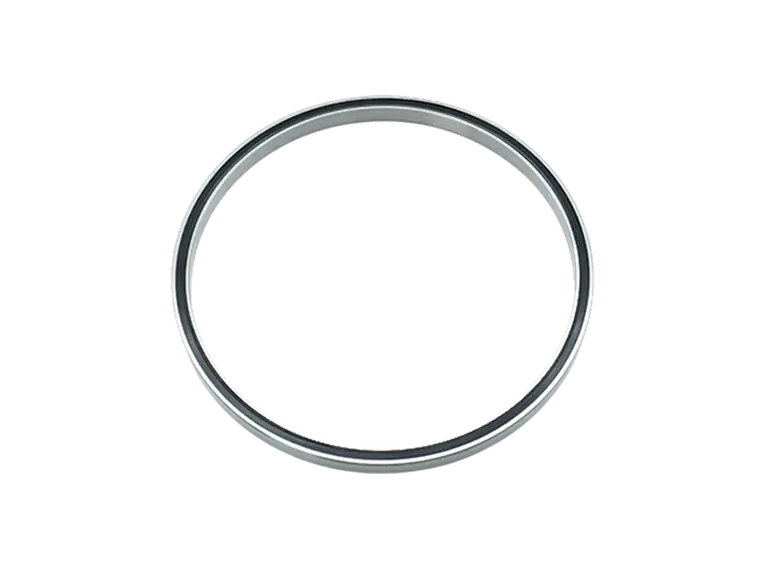
GCr15, also designated 100Cr6 or AISI 52100, is the baseline material for most precision crossed roller bearings. It is a high-carbon chromium steel, typically with about 1.0 percent carbon and 1.5 percent chromium, and it hardens uniformly through the section when properly austenitized and quenched. Rings and rollers made from it reach 60 to 65 HRC at the surface and retain high hardness well below the raceway.
Through-hardening steel is cost-effective, widely available in tight tolerance grades, and predictable in fatigue performance when inclusion content is controlled. Its limitation is hardenability: very large ring diameters may not reach full hardness at the core, and the material offers no corrosion resistance without additional surface treatment.
Case-Carburizing Alloy Steels
Low-carbon alloys such as 20CrMnTi, 8620, and 17CrNiMo6 start with a soft, ductile core and gain a hard, wear-resistant skin through carburizing. The resulting gradient is a genuine engineering advantage for crossed roller bearings subject to shock loading, where a through-hardened ring might crack but a carburized ring will deform and recover.
Case depth is the critical variable and is normally specified as a fraction of the rolling element diameter or contact width rather than as an arbitrary number. Typical production depths for crossed roller rings fall in the range of 0.8 to 2.5 mm, with surface hardness of 58 to 62 HRC and core hardness of roughly 30 to 45 HRC. Applications include heavy-duty rotary indexing tables, construction equipment slewing joints, and any axis where impact loads are expected.
Martensitic Stainless and Corrosion-Resistant Grades
When the bearing operates in a washdown environment, a vacuum chamber, or a medical device that is repeatedly cleaned, martensitic stainless steel such as 440C becomes attractive. It hardens to about 58 to 60 HRC and resists rust without coating. The trade-off is a slightly coarser carbide structure and a lower fatigue limit than 52100, so stainless grades are specified for environmental reasons rather than for maximum load capacity.
For higher temperatures, tool steels such as M50 retain hardness where standard bearing steels begin to soften, making them suitable for applications near or above 300 degrees Celsius.
Ceramic and Hybrid Configurations
Silicon nitride rollers paired with steel rings form a hybrid bearing that weighs less, runs cooler at high speed, resists electrical erosion, and does not corrode. The rollers are expensive and demand carefully matched ring hardness, but for high-speed spindles, semiconductor equipment, and electrically exposed shafts the combination solves problems that steel alone cannot.
Heat Treatment Processes and Their Effect on Performance
Through Hardening
Rings and rollers are austenitized around 840 to 850 degrees Celsius, quenched in oil or a controlled atmosphere, then tempered between roughly 150 and 200 degrees Celsius. Tempering temperature is a deliberate compromise: higher temperatures improve toughness and dimensional stability, lower temperatures preserve hardness. A tightly controlled furnace atmosphere limits decarburization, which would otherwise soften the raceway surface and reduce fatigue life.
Case Carburizing and Carbonitriding
Carburizing holds parts in a carbon-rich atmosphere near 900 to 930 degrees Celsius long enough for carbon to diffuse into the surface, followed by a direct quench and temper. The process produces the hard case and tough core described above. Carbonitriding adds nitrogen to the atmosphere, improving hardenability and allowing lower quenching temperatures, which reduces distortion in thin-walled rings.
Induction and Localized Hardening
Some crossed roller designs use induction hardening to treat only the raceway while the rest of the ring remains machinable and tough. It is fast and distortion is limited to the heated zone, but the transition between hardened and unhardened material must be positioned away from the contact path to avoid a soft band under load.
Cryogenic Treatment and Multiple Tempering
Quenching leaves a proportion of retained austenite in the microstructure. Over time, that austenite transforms and the part changes size, which is unacceptable in a preloaded crossed roller set. Deep cooling at minus 70 to minus 196 degrees Celsius drives the transformation before final grinding, and two or three tempering cycles relieve residual stress. Suppliers targeting dimensionally stable bearings typically specify retained austenite below 3 percent.
Matching Material and Heat Treatment to the Application
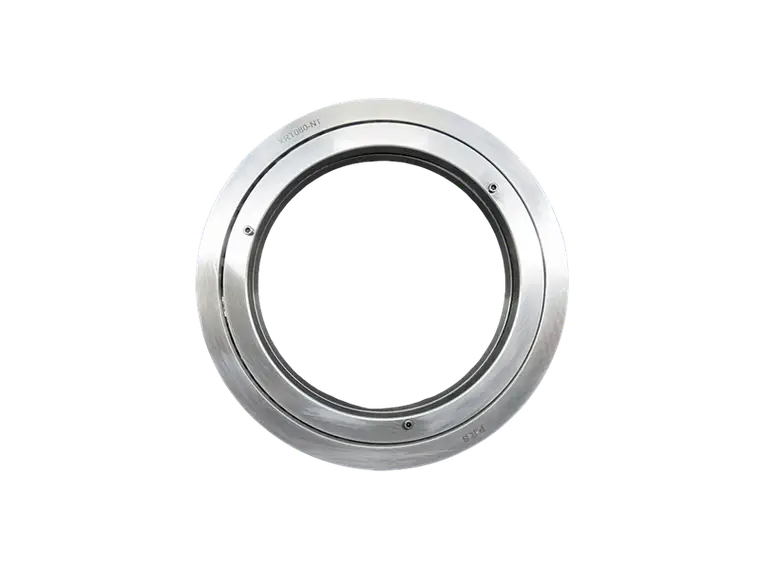
- Machine tool rotary tables and indexers: through-hardened GCr15, 60 to 62 HRC, cryogenically treated for stable preload and low running torque.
- Robot joints and articulated arms: carburized rings where shock and misalignment occur, balancing fatigue life against resistance to impact.
- Medical and semiconductor equipment: 440C stainless or hybrid ceramic rollers, chosen for cleanliness, corrosion resistance, and non-magnetic behavior.
- Heavy equipment and slewing drives: deep case carburizing with generous case depth to survive high moment loads and occasional overload.
- High-speed spindles: hybrid ceramic rolling elements with hardened steel rings, often paired with controlled preload and precision-grade surface finishes.
Verification: Confirming What Was Actually Delivered
Material and heat treatment claims are only meaningful when they can be measured. A competent supplier documents and, where required, tests the following:
- Hardness testing using Rockwell C on rings and rollers, with results traceable to a calibrated tester.
- Metallographic cross sections that reveal case depth, carbide distribution, and any decarburized layer at the surface.
- Retained austenite measurement by X-ray diffraction or magnetic methods when dimensional stability is critical.
- Chemical composition certificates for the incoming bar stock, matched against the drawing specification.
- Dimensional and runout inspection after final grinding, since heat treatment distortion must be removed rather than tolerated.
A supplier that tracks heat lot numbers from bar stock through finished grinding can trace any field failure back to its process parameters. That traceability is often the difference between a bearing that performs as specified and one that simply looks correct on arrival.
Working With a Materials-Focused Supplier
Because crossed roller bearings are frequently custom sized, the material and heat treatment specification is usually a joint decision between the buyer and the manufacturer. Suppliers such as PRS work through the load case, rotational speed, environment, and allowable envelope before recommending a grade and hardening route, then document the process so later production lots remain interchangeable. For buyers, the practical questions to ask are straightforward: which grade, what hardness range, what case depth if carburized, what retained austenite limit, and how is each of those verified on the shipping inspection report.
FAQ
Is through-hardened steel always better than carburized steel?
No. Through-hardened 52100 offers higher uniform hardness and excellent fatigue life in clean, well-aligned, moderately loaded applications. Carburized steel wins where shock loads, misalignment, or thick sections make a tough core more valuable than maximum surface hardness.
Why does case depth matter so much?
The zone of maximum shear stress sits below the contact surface. If the hardened case is thinner than that zone, the load is carried by softer material and the raceway can fatigue or deform prematurely. Too deep a case, on the other hand, removes the toughness benefit that motivated carburizing in the first place.
Can heat treatment fix a bearing that is already distorting in service?
Not after the fact. Dimensional drift usually traces back to retained austenite or insufficient stress relief during manufacturing. The remedy is a cryogenic treatment and multiple tempering steps applied before final grinding, which must be specified at the ordering stage.
Does a stainless bearing sacrifice load capacity?
It offers somewhat lower fatigue limits than 52100 and requires careful grinding because of its carbide structure. For corrosion-prone or cleanroom environments, that trade is normally worth making, and hybrid ceramic designs can recover much of the lost performance.