
Crossed roller bearings are chosen for applications where a single bearing must handle radial, axial, and tilting moment loads simultaneously — precision rotary tables, robot wrists, indexing heads, medical scanners, and semiconductor handling equipment. Their internal geometry leaves little tolerance for contamination: one particle trapped between a raceway and a cylindrical roller can raise running torque, damage the contact surface, and shorten service life. Seals and external protection are therefore not accessories but part of the bearing's performance envelope. This article explains how sealing works in crossed roller bearing assemblies, which designs suit which operating conditions, and how to specify protection that matches your precision and duty-cycle requirements.
Why Crossed Roller Bearings Are Sensitive to Contamination
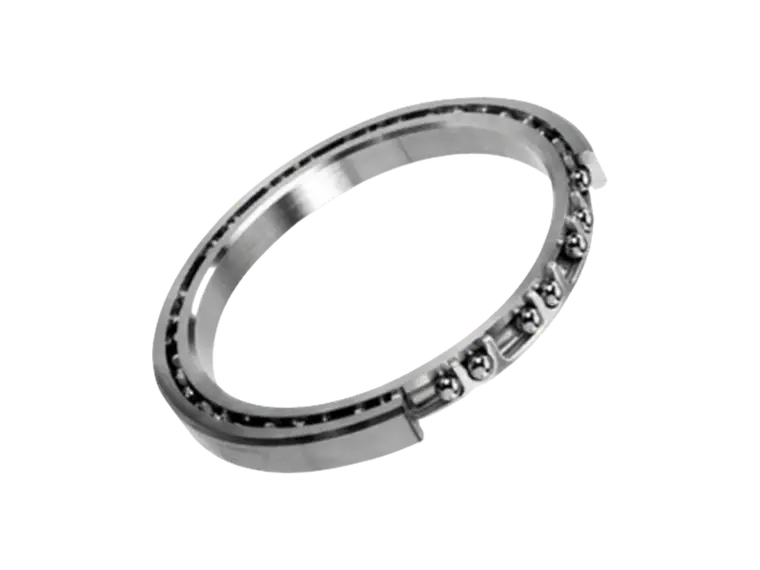
A crossed roller bearing carries load through cylindrical rollers arranged alternately at 90 degrees to each other in a single raceway groove. This arrangement gives high stiffness and accurate rotation, but it also means the rolling contact is highly stressed over a narrow line. Contaminants that would be tolerable in a deep-groove ball bearing often cause measurable damage here.
Typical intrusion paths and their effects include:
- Abrasive particles such as machining chips, grinding dust, or carbon powder, which indent raceways and generate vibration.
- Coolant and cutting fluid mist, which washes out grease and causes lubricant starvation.
- Moisture and condensation, which promote corrosion on raceway surfaces and reduce fatigue life.
- Fine airborne dust in cleanroom or vacuum environments, where even low particle counts threaten precision.
Once contamination enters, it is difficult to remove. Retrofitting a seal after the bearing is mounted in a housing is rarely practical, so protection must be specified at the design stage.
Seal Designs Used in Crossed Roller Bearing Assemblies
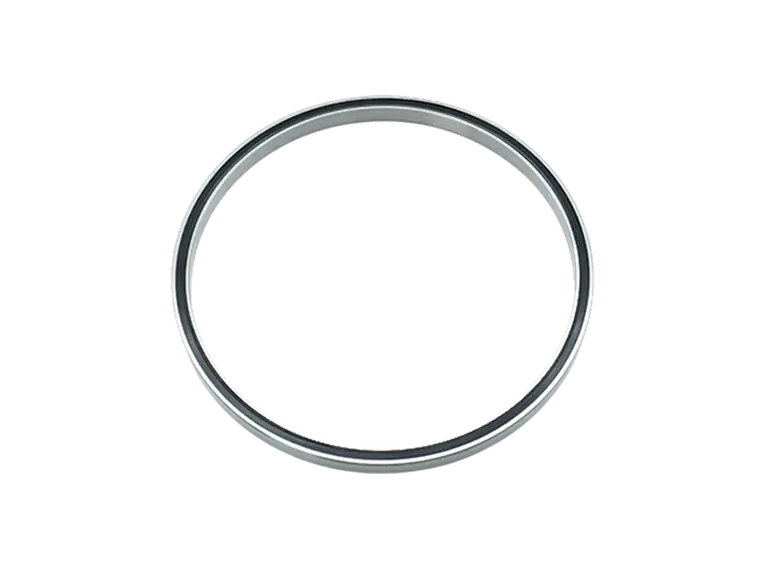
Manufacturers generally offer three families of sealing, and the right choice depends on speed, torque budget, environment, and maintenance access.
Contact Seals: Rubber Lips, V-Rings, and Wiper Profiles
Contact seals press a flexible lip against a mating surface, usually the inner or outer ring shoulder, and provide the most effective barrier against fine particles and liquids. Nitrile (NBR) is the standard material for general industrial use, while fluoroelastomer (FKM) and silicone grades extend the temperature range and improve chemical resistance. A contact seal adds friction torque, so it is normally paired with a lower-viscosity grease or a slightly higher drive margin. At high rotational speeds, lip temperature becomes the limiting factor rather than bearing capacity.
Non-Contact Seals: Labyrinth and Gap Seals
Labyrinth seals create a tortuous path between rotating and stationary parts without any rubbing contact. They generate essentially no additional torque and do not wear, which makes them attractive for high-speed spindles and for applications with long, unattended service intervals. The trade-off is a small, controlled leakage path: labyrinth seals resist larger debris and splash but are not fully effective against fine dust or fluid flooding unless they are combined with a grease barrier or purge air.
Combined and Custom Protection Arrangements
Many precision assemblies use a composite approach — an outer labyrinth to reject bulk debris, an inner contact lip to stop fine particles, and a grease-filled cavity between the two. In harsh environments, a bellows or telescopic cover protects the exposed section of a rotating stage, while the bearing's own seals handle residual contamination. For crossed roller bearings supplied as complete rotary table units, the housing design frequently integrates these layers directly.
Matching Seal Type to Operating Conditions
Selecting a seal is a compromise between protection, friction, and speed. The following comparison summarises the practical advantages of each option.
- Contact lip seal — advantages: highest particle and liquid exclusion; simple geometry; low cost; easy replacement in serviceable designs.
- Labyrinth seal — advantages: negligible friction torque; no wear or maintenance; suitable for high speed and wide temperature swings.
- Combined seal — advantages: best overall protection for machine tools, robotics, and outdoor equipment; tolerant of occasional washdown.
- Bellows or cover — advantages: protects the seal itself from impact, swarf, and direct spray; extends inspection intervals.
As a general rule, contact seals suit moderate speeds with aggressive contamination, labyrinth seals suit high speeds in cleaner environments, and combined arrangements are the default for machine tool and automation applications where downtime is expensive.
Protection Measures Beyond the Seal Itself
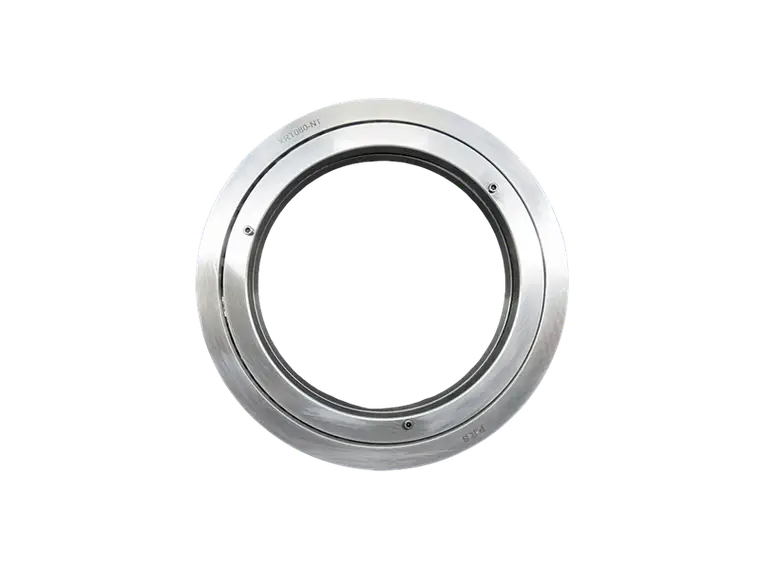
Sealing is only one layer of a protection strategy. Designers should also consider:
- Lubricant selection. A grease with good adhesion and water resistance stays in place and forms a secondary barrier at the seal lip.
- Purge or positive pressure. A small flow of clean, dry air inside the housing keeps contaminants moving outward.
- Housing geometry. Grooves, flingers, and drainage channels prevent liquid from pooling against the seal.
- Mounting accuracy. Misalignment increases lip pressure on one side of a contact seal and opens the gap on a labyrinth, so both must be installed within the specified runout limits.
- Maintenance access. Grease relief ports and replaceable seal carriers reduce the cost of long-term upkeep.
Selection, Installation, and Maintenance Notes
When specifying a sealed crossed roller bearing, confirm the operating speed against the seal's permissible surface speed, verify chemical compatibility between the elastomer and any coolant or cleaning agent, and check that the seal does not restrict the lubrication path. During installation, keep the seal lip lubricated before assembly, avoid rolling the lip over sharp edges, and never reuse a deformed seal. In service, monitor running torque and temperature: a gradual rise usually indicates lubricant breakdown or lip wear, while a sudden rise suggests contamination has already entered.
Working with an experienced supplier matters here. PRS supports customers in reviewing seal configuration alongside load, speed, and environment data so that the bearing and its protection are specified as one system rather than two separate purchases.
Frequently Asked Questions
Can a crossed roller bearing be operated without seals?
Yes, in clean, controlled environments such as sealed gearboxes or laboratory instruments. In any environment with dust, chips, or moisture, an unsealed bearing will lose precision and accuracy far earlier than its calculated fatigue life suggests.
Do seals reduce load capacity?
Seals do not change the bearing's static or dynamic load rating, but the friction torque they add must be accounted for in the drive sizing and thermal budget.
How often should seals be replaced?
Replacement intervals depend on speed, temperature, and contamination level. Inspect seals at every scheduled lubrication service and replace them whenever the lip shows hardening, cracking, or visible wear.
Effective protection of a crossed roller bearing comes down to matching the seal to the real environment rather than the catalogue average. Contact seals, labyrinth seals, and combined arrangements each solve a different problem, and their value is multiplied when housing geometry, lubricant choice, and maintenance access are designed around them. Specifying protection early keeps precision stable, torque predictable, and service life close to the calculated figure.