
When a machine's positioning accuracy depends on a single bearing interface, the choice between crossed roller bearings and ball bearings stops being a catalog detail and becomes a design decision. Both types can carry radial, axial, and moment loads, and both are offered in similar envelope sizes, yet they behave very differently under load, at speed, and over thousands of operating hours. Engineers comparing the two usually care about stiffness, load capacity, mounting height, friction, and total cost — not simply which bearing spins more freely. This guide breaks down the mechanical and practical differences between crossed roller and ball bearings so you can match the bearing to the application instead of forcing the application to fit the bearing you already have.
The Mechanical Difference at a Glance
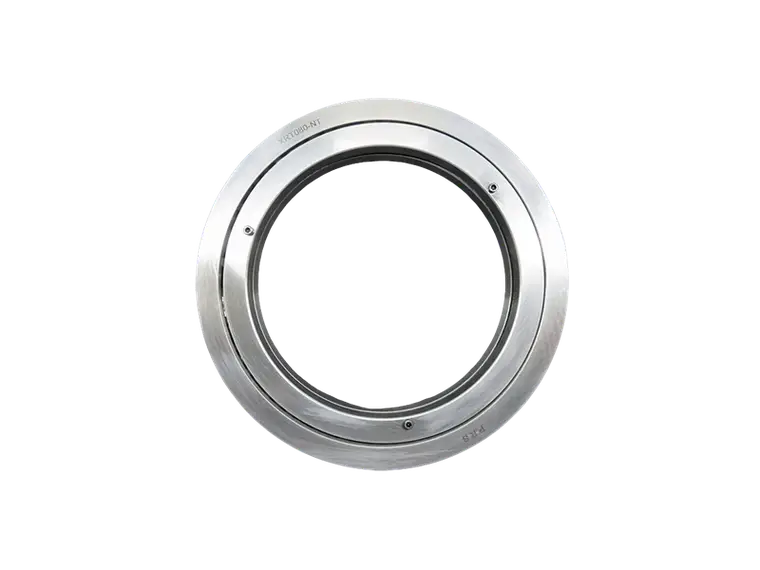
A crossed roller bearing places cylindrical rollers in a single raceway and alternates their axes by 90 degrees. Adjacent rollers therefore contact the raceway in opposing directions, which allows one bearing to resist radial loads, axial loads in both directions, and tilting moments simultaneously. Ball bearings, by contrast, use spherical rolling elements. In a standard deep groove or angular contact design, the balls handle load in one or two directions depending on the arrangement, so supporting combined loads often requires two bearings mounted apart or a four-point contact configuration.
Line Contact vs. Point Contact
The consequences of that geometry are significant. A cylindrical roller touches its raceway along a line; a ball touches along a theoretical point that grows into a small ellipse under load. Line contact distributes force across a much larger area, which lowers contact stress and produces far less elastic deflection for the same applied load. Point contact produces lower rolling resistance but concentrates stress, which is why ball bearings tend to be chosen for speed and crossed rollers for stiffness.
Load Capacity and Structural Rigidity
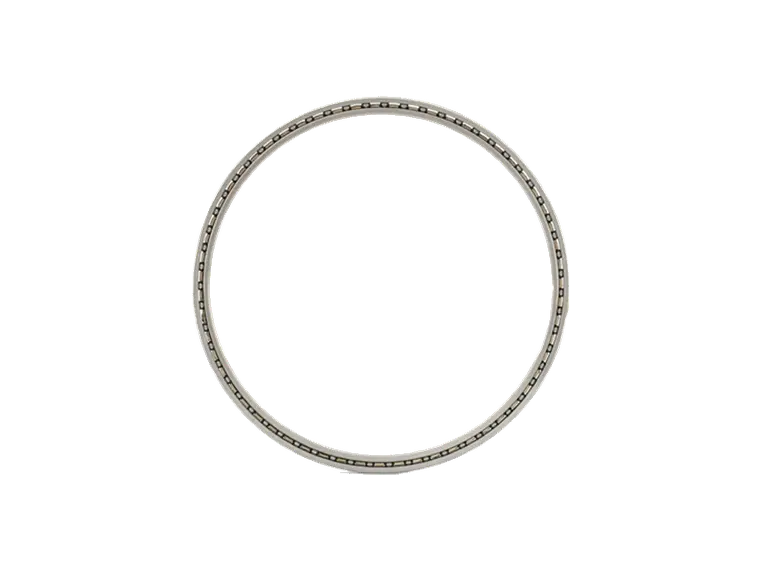
For a given envelope, a crossed roller bearing generally offers substantially higher load capacity and much greater rigidity than a comparable ball bearing. That is not a marketing claim so much as a direct result of contact geometry: the load is spread over more material, and the rolling elements deform less when the load is applied. In practice, designers notice this most in two situations — heavy axial or moment loads, and applications where deflection must stay within a few micrometers.
Ball bearings remain competitive when loads are light and the design priority is low drag, low cost, or high rotational speed. A thin-section ball bearing can be surprisingly capable in a compact space, but it will deflect more under the same moment, and that deflection frequently shows up as lost positioning accuracy at the tool tip or the end effector.
Why Rigidity Often Matters More Than Rated Capacity
Rated load capacity tells you when a bearing will fail. Stiffness tells you how well it will perform. A bearing that survives the load but deflects visibly under a cutting force or an indexing moment will produce chatter, poor surface finish, or inconsistent measurement. Crossed roller bearings are usually selected precisely because their load-deflection curve stays flat across the working range.
Precision, Runout, and Positioning Accuracy
Both bearing families are available in high-precision grades, and both can achieve very low runout when manufactured and mounted correctly. The difference is stability under changing conditions. Because crossed rollers deflect less, the axis of rotation shifts less when the load varies — during a robotic arm's extension, for example, or when a rotary table picks up an off-center workpiece. Ball bearings can match static accuracy in a controlled test rig, but the accuracy tends to degrade more as loads and moments increase.
Crossed roller bearings also simplify the tolerance stack. One bearing, one mounting surface, one preload setting — instead of two bearings separated by a housing whose bore alignment must be controlled.
Speed, Friction, and Driving Torque
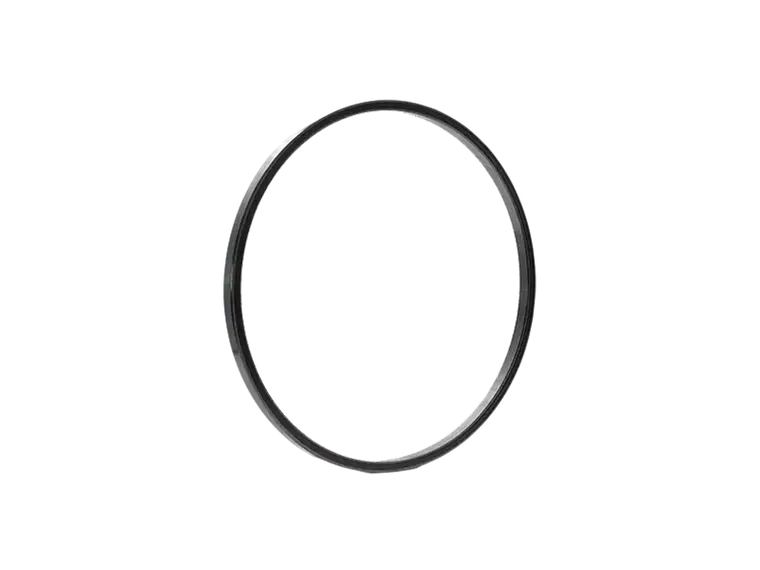
This is where ball bearings take the lead. Point contact means lower rolling friction, lower starting torque, and less heat generation at speed. For continuous rotation at high RPM, a ball bearing is almost always the practical choice. Crossed roller bearings are better suited to slow rotation, oscillating motion, indexing, and positioning axes where torque is provided by a gearbox or a servo motor with ample margin.
Lubrication matters for both. Crossed rollers, with their larger contact area, depend on a consistent lubricant film to keep friction and wear in check, so seal design and relubrication intervals deserve attention early in the project.
Crossed Roller vs Ball Bearings: Side-by-Side Comparison
- Load capacity: Crossed rollers carry higher radial, axial, and moment loads in the same envelope; ball bearings carry less per unit size.
- Rigidity: Crossed rollers deflect far less under combined loads; ball bearings are more compliant, especially under moment loading.
- Accuracy under load: Crossed rollers hold runout and positioning accuracy more consistently; ball bearings hold accuracy only while loads stay low.
- Speed capability: Ball bearings win clearly, with lower friction and less heat at high RPM.
- Starting torque: Ball bearings require less torque to initiate motion; crossed rollers need more, particularly when preloaded.
- Design complexity: Crossed rollers replace two bearings with one and simplify the housing; ball bearings frequently require paired mounting and careful alignment.
- Unit cost: Ball bearings are usually cheaper individually; crossed rollers cost more but may reduce total part count and machining.
- Typical applications: Crossed rollers suit rotary tables, robot joints, index mechanisms, and machine tool axes; ball bearings suit spindles, motors, fans, and light-duty pivots.
Space, Mounting, and Cost of Ownership
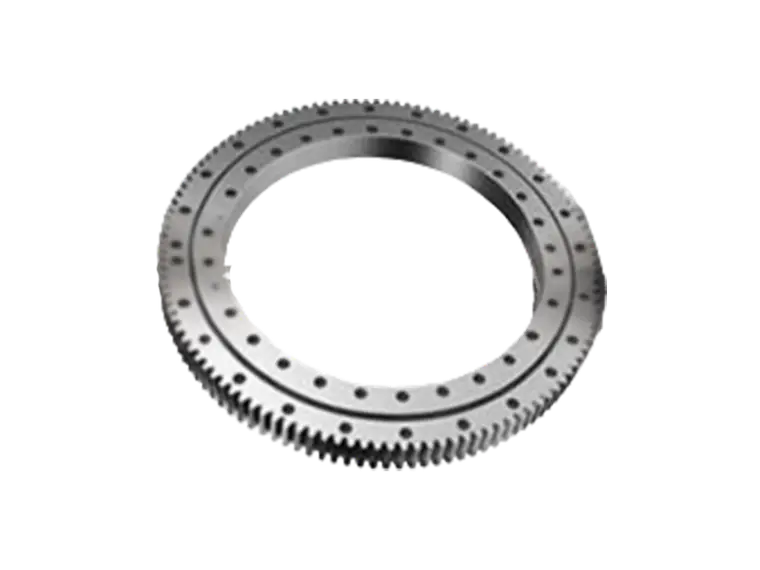
Bill-of-materials comparisons can be misleading. A crossed roller bearing may cost several times more than a single ball bearing, but if it eliminates a second bearing, a precision-machined spacer, and a two-bore housing that must be aligned within tight tolerances, the assembly can end up cheaper to build and far easier to service. Mounting height is another factor — crossed rollers often fit into a shallower axial space for the same load capability.
When the Cheaper Bearing Is the Expensive Choice
If deflection forces you to add a stiffer frame, a larger motor, or a compensation routine in the control software, the savings from a low-cost ball bearing disappear quickly. Conversely, specifying crossed rollers for a high-speed spindle wastes money and creates a thermal problem. The right answer depends on which parameter drives the design.
How to Decide: A Practical Selection Path
- Define the load case: radial, axial, moment, or a combination, including shock and fatigue cycles.
- Set an allowable deflection, not just an allowable stress. This single number usually decides the question.
- Check the speed. Continuous high-speed rotation points toward ball bearings; slow indexing and oscillating motion favor crossed rollers.
- Evaluate the envelope. If mounting height or bore spacing is tight, a single crossed roller bearing may be the only clean solution.
- Compare total assembly cost, including housing machining, alignment fixtures, and assembly labor.
- Confirm preload, lubrication, and sealing requirements with the manufacturer before finalizing the drawing.
Suppliers that produce both families, such as PRS, can compare options against a real load case rather than steering every inquiry toward one product line.
Frequently Asked Questions
Can a ball bearing replace a crossed roller bearing?
Sometimes, but rarely without consequences. If the application is lightly loaded, runs at speed, and tolerates a few micrometers of extra deflection, a ball bearing may work. In a rotary table, robot joint, or machine tool axis, replacing crossed rollers with balls usually shows up as reduced stiffness and degraded accuracy under load.
Are crossed roller bearings always more accurate?
Not inherently — manufacturing grade determines base accuracy. The advantage is that crossed rollers maintain their accuracy better when loads change, because they deflect less. A high-grade ball bearing can be extremely precise in a static, lightly loaded condition.
Do crossed roller bearings need more lubrication?
They need reliable lubrication rather than necessarily more of it. Because the rollers contact the raceway along a line, the lubricant film must be maintained across the full contact width. Seals, grease selection, and relubrication intervals should be specified with the bearing, not added later.
Which type handles moment loads better?
Crossed roller bearings handle moment loads far better in a single bearing. A ball bearing arrangement can carry the same moment, but typically requires two bearings spaced apart, which increases stack height and alignment sensitivity.
Closing Perspective
The comparison between crossed roller and ball bearings is not a contest with a single winner. It is a question of which compromise your design can tolerate. Ball bearings trade stiffness for speed and low cost; crossed rollers trade speed for rigidity, accuracy, and simplicity of mounting. Identify the one parameter your machine cannot afford to lose — deflection, RPM, or build cost — and the choice usually makes itself. When the margins are close, an application review with an experienced bearing supplier is worth more than a catalog page, because the deciding factor is often how the bearing behaves in your assembly, not how it performs on a test bench.