

Rotary tables are among the most demanding applications in precision machining, metrology, and automated assembly. They must rotate with exceptional accuracy while simultaneously supporting axial, radial, and tilting loads. The bearing selected for a rotary table directly determines its rigidity, positioning repeatability, and service life. Crossed roller bearings have emerged as the preferred solution for these challenges because their structure fundamentally addresses the load and precision requirements that conventional bearings struggle to meet.
What Makes Rotary Tables So Demanding for Bearings
A rotary table is not simply a rotating platform. It is a positioning system expected to hold angular accuracy in the arc-second range, resist deflection under cutting forces, and maintain smooth motion across a wide range of speeds. These requirements create a complex load environment.
When a workpiece is mounted off-center, the table experiences a tilting moment. When a cutting tool engages, it introduces radial and axial forces simultaneously. When the table indexes from one position to another, friction and inertia must be carefully controlled. A bearing that handles only one type of load would require additional support bearings, increasing size, weight, and assembly complexity.
The ideal bearing for a rotary table must therefore provide:
- High tilting rigidity to minimize deflection under offset loads
- Simultaneous support for radial, axial, and moment loads
- Low and consistent friction torque for smooth, precise rotation
- Compact cross-section to fit within the table structure
- High rotational accuracy to maintain angular positioning
Meeting all five requirements in a single bearing unit is precisely where crossed roller bearings differentiate themselves.
How Crossed Roller Bearings Are Constructed
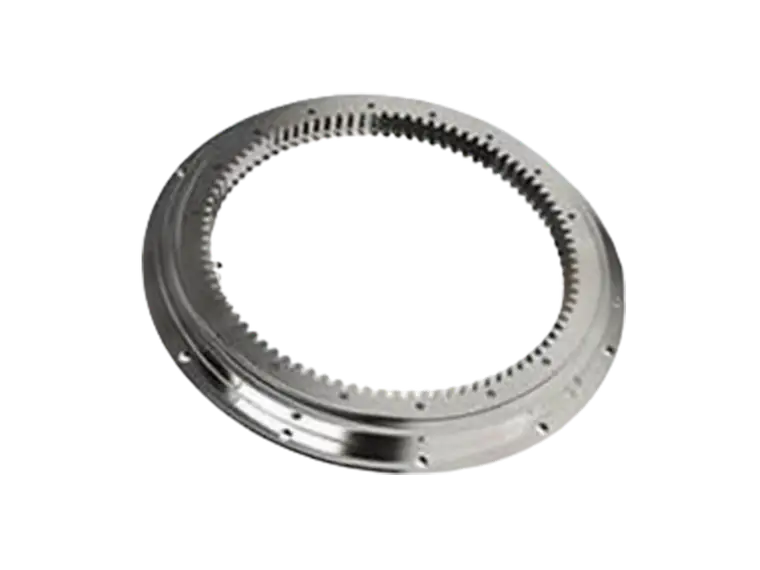
The defining feature of a crossed roller bearing is the arrangement of its cylindrical rollers. Rather than positioning rollers in a single direction, the rollers are arranged at 90-degree intervals to one another, alternating in a crossed pattern around the raceway. Spacers or a cage separate adjacent rollers to prevent skewing and maintain consistent spacing.
The 90-Degree Alternating Arrangement
Because rollers alternate between two perpendicular orientations, each roller contacts the raceway along a line rather than a point. One set of rollers handles axial loads in one direction while the other set handles radial loads and axial loads in the opposite direction. The result is a bearing that supports loads from every direction within a single, compact unit.
Line Contact and Load Distribution
Unlike ball bearings, which contact the raceway at a single point, cylindrical rollers contact along a line. This line contact distributes force over a larger area, reducing contact stress and allowing the bearing to carry heavier loads without permanent deformation. In a crossed roller bearing, this advantage is multiplied because the load is shared across multiple rollers simultaneously engaged in different orientations.
The crossed arrangement also means that the bearing's stiffness is not direction-dependent. Tilting rigidity, radial rigidity, and axial rigidity are all high and relatively uniform, which simplifies the designer's task of predicting table deflection under load.
Direct Advantages Over Conventional Bearing Options
Engineers evaluating bearing solutions for rotary tables typically consider several alternatives. The comparison below highlights where crossed roller bearings provide measurable benefits.
- Versus angular contact ball bearings: Ball bearings require preloading in pairs and still provide lower tilting rigidity. Crossed roller bearings deliver higher stiffness in a single unit, reducing the number of components and simplifying assembly.
- Versus tapered roller bearings: Tapered bearings handle combined loads but require two opposed units for bidirectional axial support. Crossed roller bearings manage both directions within one bearing, saving axial space.
- Versus thrust bearings combined with radial bearings: This arrangement is bulky and introduces additional interfaces that can reduce overall system accuracy. Crossed roller bearings consolidate functions into one precision component.
- Versus slewing ring bearings: Slewing rings are designed for large-diameter, lower-precision applications. Crossed roller bearings offer higher rotational accuracy and are better suited to compact, high-precision tables.
These advantages do not mean crossed roller bearings are universally superior. They are the right choice when high rigidity, compactness, and precision are the dominant requirements. That is precisely the profile of most rotary table applications.
Applications Where Crossed Roller Bearings Prove Their Value
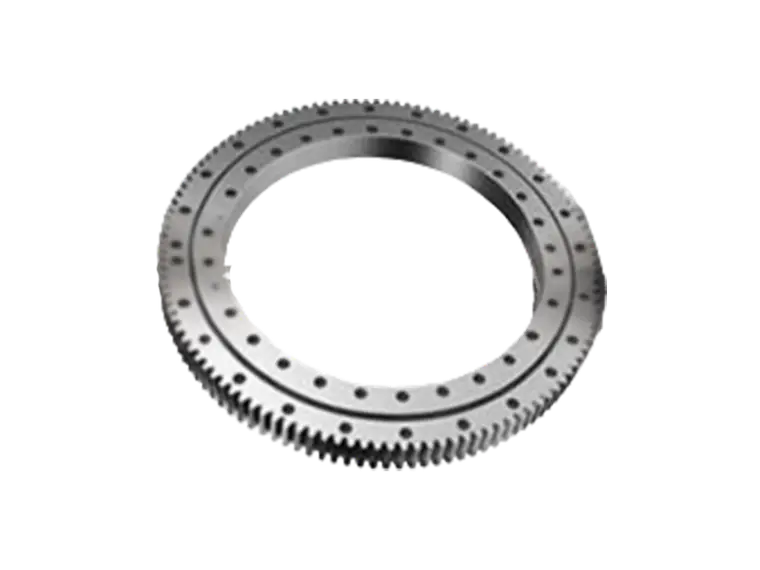
Crossed roller bearings are found in rotary tables across a range of industries and precision levels. In machine tool rotary tables, they support the workpiece during milling, grinding, and turning operations where cutting forces would otherwise cause deflection. In semiconductor manufacturing equipment, they enable the fine angular adjustments required for wafer inspection and lithography. In medical imaging systems and optical measurement devices, they provide the smooth, repeatable rotation needed for accurate data capture.
PRS has supplied crossed roller bearings for rotary table applications where standard catalog products could not meet the required stiffness or accuracy targets. In these cases, the bearing's internal clearance, preload, and raceway geometry were optimized to match the specific load and precision profile of the application.
Selection Factors for Rotary Table Bearings
Choosing the correct crossed roller bearing for a rotary table involves more than matching dimensions. Several performance parameters must be evaluated together.
Load Capacity and Safety Margin
The bearing must support the maximum combined load the table will encounter, including dynamic forces during cutting or acceleration. A safety factor is typically applied to account for unexpected loads or shock. Because crossed roller bearings handle axial, radial, and moment loads simultaneously, the rating must be evaluated for the combined load case, not each direction in isolation.
Preload and Rigidity
Preload removes internal clearance and increases rigidity, but excessive preload raises friction torque and reduces service life. The correct preload depends on the required positioning accuracy and the expected load direction. For rotary tables used in precision positioning, a light to medium preload is often specified to balance stiffness and smooth operation.
Accuracy Class and Runout
Rotational accuracy is defined by the bearing's axial and radial runout. For high-precision rotary tables, bearings with tight runout tolerances are required. The mounting surfaces on the table and housing must also be machined to comparable tolerances, since even a precisely manufactured bearing cannot compensate for poor mounting geometry.
Lubrication and Sealing
Proper lubrication reduces friction and protects the raceways from wear. The choice between grease and oil depends on speed, load, and operating temperature. Seals or shields prevent contamination from reaching the raceway, which is critical in machining environments where chips and coolant are present.
Why Crossed Roller Bearings Remain the Standard for Precision Rotary Tables
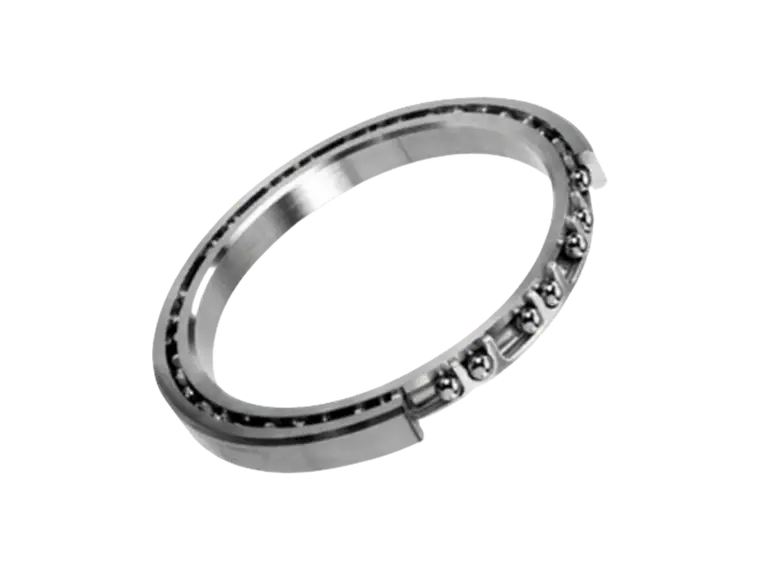
The combination of high rigidity, compact design, and multi-directional load support makes crossed roller bearings uniquely suited to rotary table applications. They reduce component count, simplify assembly, and provide predictable performance under complex load conditions. For engineers designing equipment where angular accuracy and structural stiffness are non-negotiable, the crossed roller bearing is not simply an option. It is the logical foundation.
As rotary table designs continue to push toward higher speeds, tighter tolerances, and smaller footprints, the demand for bearings that can keep pace will only increase. Crossed roller bearings are positioned to meet that demand because their fundamental geometry aligns with the physics of precision rotation.