
Crossed roller bearings are rarely the most visible part of a machine, yet they often decide how accurately it moves. Because a single unit carries radial, axial and tilting moment loads at the same time, engineers specify them whenever a rotating axis must stay rigid, repeatable and compact. That combination appears across robotics, machine tools, semiconductor equipment, medical imaging and aerospace instrumentation, where a few micrometres of error become a product defect or a failed inspection. This guide reviews the most common applications of crossed roller bearings, explains why they are chosen over alternative arrangements, and outlines the factors that matter most when specifying one for a new design.
How a Crossed Roller Bearing Works and Why It Matters
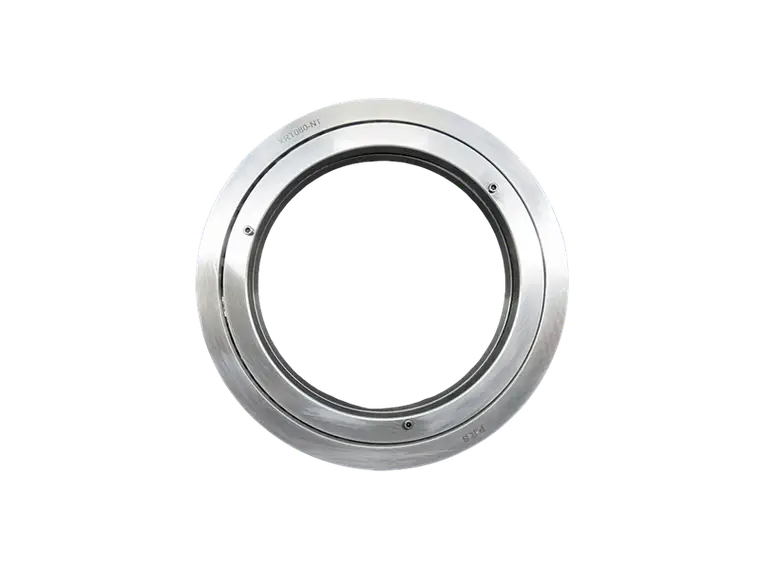
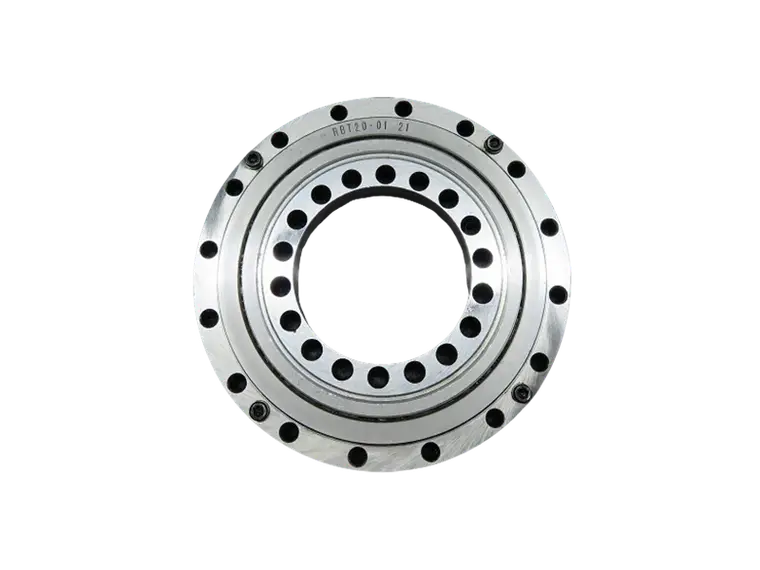
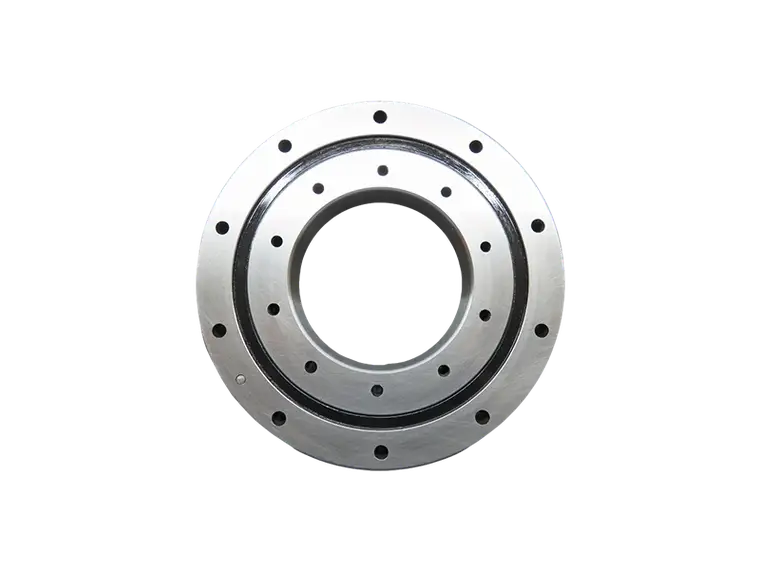
In a crossed roller bearing, cylindrical rollers are arranged in an alternating sequence, each rotated 90 degrees relative to its neighbour, and held apart by spacers or a cage. The raceways are ground as V-shaped grooves with a 90-degree included angle, so every roller contacts the raceway along two lines. The result is a bearing that handles radial loads, axial loads in both directions and tilting moments simultaneously, without a second bearing to control the moment.
That single-bearing load capability has direct design consequences. The axis becomes shorter, the housing simpler and the stiffness higher, because the rolling elements run in line contact rather than point contact. Compared with a pair of angular contact bearings, the assembly needs less axial space, fewer components and less adjustment during mounting. For applications where positioning accuracy and repeatability are the primary requirements, this is often decisive.
Top Applications of Crossed Roller Bearings
Industrial and Collaborative Robots
Robot joints are among the most demanding duties for any precision bearing. A shoulder, elbow or wrist axis must support a payload at the end of a long lever arm, which generates significant tilting moment, while still holding repeatability in the sub-0.1 mm range through millions of cycles. Crossed roller bearings are commonly fitted at the output of harmonic and cycloidal drive units and at the base rotation of articulated arms, where their rigidity limits deflection under load and their compact height keeps the joint envelope small. In collaborative robots, smooth running and low backlash also matter for force control and for safe, predictable motion.
Machine Tools and Rotary Tables
CNC rotary tables, index tables, vertical lathes, milling heads and grinding spindles rely on crossed roller bearings to keep the workpiece or tool stable under cutting force. Rigidity here is not an abstract quality: insufficient stiffness shows up as chatter, poor surface finish and vibration that shortens tool life. Because the bearing also controls the tilting moment, the table structure can be built lighter while runout stays low, which directly supports the accuracy of interpolated and multi-axis machining. Paired with an angular encoder, the same bearing provides the stable rotation reference the control loop needs.
Semiconductor, Flat Panel and Optical Metrology
Wafer stages, goniometers, inspection turntables and mask alignment systems demand motion that is both extremely smooth and extremely repeatable. In these machines, crossed roller bearings are selected for low starting torque, high tilt stiffness and options such as cleanroom-compatible lubrication, non-magnetic materials and special surface treatments. A bearing that is slightly rough or that releases particles can contaminate a process environment, so bearing selection is treated as part of contamination control, not merely as a mechanical detail.
Medical Imaging and Surgical Equipment
CT gantries, C-arms, dental scanners, radiation therapy positioning systems and surgical robots all rotate a heavy assembly around a patient. Accuracy determines image quality and targeting precision, while smoothness determines noise and patient comfort. Crossed roller bearings suit these axes because they combine high moment stiffness with quiet, uniform rotation, and because they can be supplied with greases and seals suited to repeated sterilisation or continuous duty.
Aerospace, Defense and Instrumentation
Radar pedestals, optical gimbals, star trackers, antenna positioners and stabilised sensor platforms frequently use crossed roller bearings in thin-section formats. Weight and envelope are tightly constrained, so the ability to replace two bearings with one, and to use a large bore relative to the outside diameter, offers a real mass and volume advantage. High stiffness also helps maintain boresight alignment when loads shift between axes.
Other Precision Rotation Duties
- Tool changers and pallet exchange systems in automated production lines
- Packaging and labelling turrets with indexing rotation and side loads
- Optical and laser scanning heads that must rotate without runout
- Test benches and calibration fixtures needing a metrology-grade rotation axis
Why Crossed Roller Bearings Are Chosen Over Alternatives
The comparison below reflects the general engineering trade-offs that drive specification decisions.
- Versus a single-row ball bearing: a crossed roller bearing offers far higher tilt stiffness and load capacity in the same envelope, using line contact instead of point contact.
- Versus a pair of angular contact bearings: one bearing replaces two, removes the need to set a matched pair, and uses less axial length for the same moment capability.
- Versus tapered roller bearings: crossed rollers run with lower friction and are easier to preload for precision positioning, while tapered bearings are more often used for heavy radial duty at moderate speed.
- Versus thin-section ball bearings: crossed rollers typically deliver greater stiffness for a given section height, which matters when the axis is short and stiff by design.
Selection Factors That Decide Whether the Application Succeeds
- Load case: quantify radial and axial loads plus the maximum tilting moment, including shock and payload offset conditions.
- Accuracy grade: running accuracy and tolerance class must match the positioning error budget, not exceed it unnecessarily.
- Preload and clearance: preload raises stiffness and removes play but increases friction and heat; the correct setting depends on duty cycle and speed.
- Mounting arrangement: whether the inner or outer ring rotates affects rigidity, sealing and lubrication choices.
- Environment: temperature range, vacuum, cleanroom class, coolant exposure and washdown all influence cage material, seals and grease.
- Supplier capability: consistent geometry, controlled preload and traceable inspection are what turn a bearing specification into repeatable machine performance.
Frequently Asked Questions
Can a crossed roller bearing support both radial and axial loads at once?
Yes. The alternating roller orientation allows it to carry radial load, bidirectional axial load and tilting moment simultaneously, which is why a single bearing can often replace a more complex arrangement.
Are crossed roller bearings suitable for continuous rotation?
They are widely used in continuous and indexing rotation, including turntables and gantries. Speed limits depend on lubrication, preload, cage design and heat dissipation, so the duty cycle should be reviewed with the bearing supplier.
What accuracy grades are available?
Precision crossed roller bearings are produced in graduated accuracy classes corresponding to international tolerance standards, from general precision through to metrology-grade. The required grade follows directly from the machine error budget.
Do they require special mounting surfaces?
Yes. Because the bearing is stiff, any error in the mating surfaces is transferred into the rotation. Flat, parallel and adequately rigid shoulders and housing faces are essential to achieve the rated accuracy.
Working With the Right Bearing Partner
Crossed roller bearings reward careful specification. The applications above share one trait: the bearing is not a commodity item but a functional element of the machine accuracy chain. Selecting the correct size, clearance, accuracy class and lubrication therefore has more influence on final performance than any single downstream adjustment.
PRS supplies precision crossed roller bearings for robotics, machine tool, semiconductor, medical and instrumentation programmes, supporting customers from early design review through to volume production. Sharing the real load case, mounting geometry and duty cycle early in a project allows the bearing to be matched to the axis rather than fitted around it, which is where accuracy, service life and cost are ultimately decided.