

Specifying a crossed roller bearing is rarely only a question of bore size and load rating. Two parameters, preload and clearance, determine how the bearing actually behaves once it is installed: how stiff the axis feels, how much torque the drive must overcome, how accurately the load position repeats, and how long the raceways survive. Engineers who understand the difference between a clearance bearing and a preloaded one can match the bearing to the machine instead of compensating for it later with servo tuning and thermal workarounds. This article explains what preload and clearance mean in a crossed roller bearing, how each option affects stiffness, friction, accuracy and life, and how to select and set the right condition for a given application.
What Preload and Clearance Actually Mean
In any rolling bearing, the rolling elements do not fill the space between the raceways perfectly. A small gap exists, and the size of that gap, or the force used to close it, is what engineers call clearance or preload. The two conditions sit at opposite ends of the same scale, and moving along that scale changes nearly every performance characteristic of the bearing.
Clearance: Intentional Play Between Rolling Elements and Raceways
Clearance, also called axial or radial play, is the amount of free movement available in the bearing before the rolling elements contact both raceways under load. In a crossed roller bearing, where cylindrical rollers are arranged at ninety degrees to one another in a single raceway, this play is usually expressed as axial displacement measured with a light gauge load. A bearing supplied with clearance turns freely by hand, generates minimal friction torque, and tolerates small misalignments and thermal expansion without binding. The trade-off is a softer axis: the load has to move through the clearance before the bearing begins to resist, which reduces positioning stiffness and repeatability.
Preload: Removing Play to Create Controlled Elastic Deformation
Preload is the opposite approach. The bearing is assembled or adjusted so that the rolling elements are already pressed against both raceways with a defined force, eliminating free play and creating a small, controlled elastic deformation at the contact points. Because the contact area is already loaded, additional external load meets an immediate, stiffer response. Preload is therefore the standard choice when the goal is high rigidity, precise positioning, or zero measurable backlash in a rotary or linear axis. The cost is higher friction torque, more heat, and a reduced margin for misalignment.
The Standard Preload and Clearance Grades
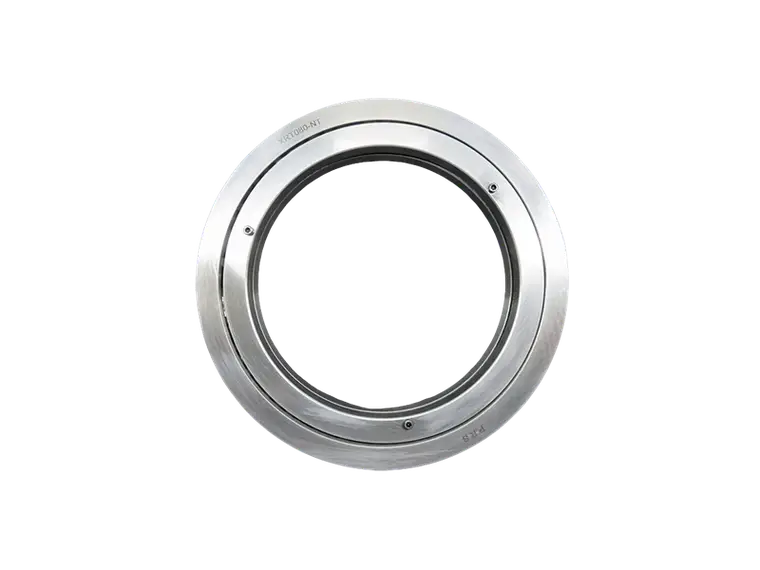
Manufacturers normally classify crossed roller bearings into a small number of preload or clearance grades so that designers can specify a condition rather than a micrometer value. Exact figures vary by size and series, but the categories are consistent across the industry:
- Clearance grade — measurable axial play. Used where friction and heat must stay low and positioning accuracy is not critical.
- Light preload — play eliminated, minimal contact deformation. The usual compromise for general automation and moderate precision.
- Medium preload — higher contact deformation for noticeably greater stiffness. Typical for machine tool indexing tables and precision rotary axes.
- Heavy preload — maximum rigidity for high-frequency, high-accuracy positioning. Requires careful thermal and torque management.
These designations describe an installed condition, not a loose part dimension. A bearing measured on the bench may show play that disappears once the mounting flanges are tightened, which is why the setting method and the housing stiffness matter as much as the grade on the drawing.
How the Choice Affects Bearing and Machine Performance
Moving from clearance toward preload is not a simple upgrade. Each step changes several behaviors at once, and the effects have to be weighed against the actual demands of the application.
Stiffness and Deflection Under Load
Preload removes the flat region of the load-deflection curve. In a clearance bearing, the first portion of any applied load is absorbed by closing the gap, so deflection is high at low load. A preloaded bearing starts on the stiff part of the curve, so deflection per unit of load is far lower and, more importantly, far more predictable. This directly improves servo bandwidth and reduces the settling time of a positioning axis.
Running Torque and Heat Generation
Friction torque rises roughly with the preload force, because every roller is in permanent contact under load. Higher torque means more heat, and heat means thermal expansion that can consume the preload or, in the worst case, overload the bearing. Systems running at high speed or in a thermally constrained enclosure often benefit from lighter preload or clearance, even at the cost of some stiffness.
Rotational Accuracy and Repeatability
Runout and repeatability improve with preload because the rollers are continuously seated against the raceways. There is no re-seating action each time the direction of load reverses, which is exactly the effect that produces backlash-related positioning error in clearance bearings.
Fatigue Life and Reliability
Preload reduces life in a purely theoretical sense, since the bearing carries a permanent internal load before any external work is applied. In practice, a correctly preloaded bearing can outlast a clearance bearing in reversing or vibrating applications, because it eliminates the impact loading that occurs when rollers cross the clearance gap. Excess preload, however, is one of the most common causes of premature raceway fatigue and overheating.
Selecting Preload or Clearance for Your Application
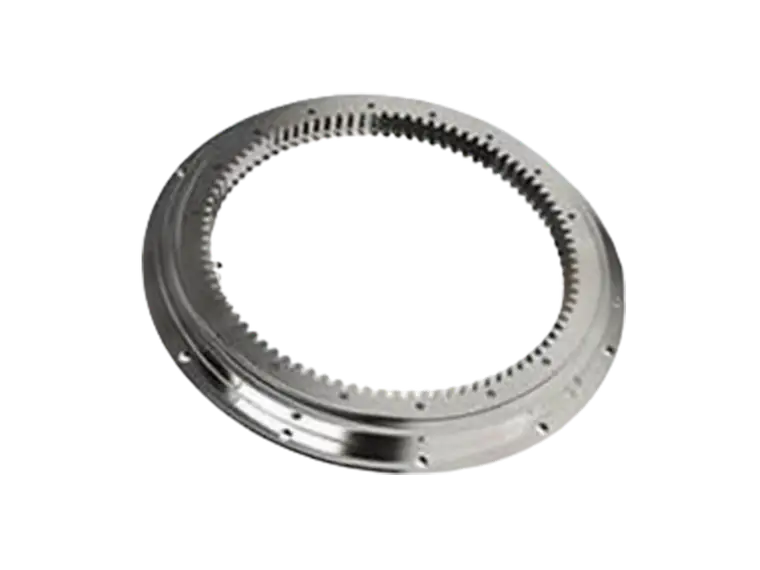
The right choice follows from what the axis must do, not from a preference for tight or free running.
- Clearance is usually appropriate for: low-torque drives, high-speed rotation, applications with significant thermal growth, and axes where position is not controlled in a closed loop.
- Light preload suits: general industrial automation, robot wrists, indexing mechanisms and light machining where stiffness matters but torque and cost must stay moderate.
- Medium to heavy preload suits: machine tool rotary tables, semiconductor wafer stages, measuring instruments, medical imaging gantries and any axis expected to hold sub-micron or arc-second accuracy under reversing load.
A practical selection sequence looks like this:
- Define the required positional accuracy and repeatability at the load point, not at the bearing.
- Calculate the external loads, including moment loads and any overhung geometry.
- Estimate the thermal environment and the expected temperature difference between inner and outer rings.
- Check the available drive torque and the acceptable friction contribution of the bearing.
- Match the resulting requirement to a standard preload or clearance grade, then confirm with the supplier.
Measuring and Setting Preload During Assembly
Preload is rarely delivered as a finished, unchangeable property. In most crossed roller bearing installations it is created by the mounting arrangement, which means the assembly process determines the final result.
Measuring Clearance Before Setting
Baseline play is normally measured with a dial indicator while a small, known axial force is applied in both directions. The difference between the two readings is the clearance. This measurement should be taken with the bearing mounted in its actual housing, since clamping forces change the geometry.
Practical Methods for Setting Preload
Common approaches include ground spacer shims selected after measurement, a locking nut with a controlled tightening torque, matched bearing pairs, and spring or hydraulic preloading for applications where thermal variation is significant. Shim and spacer methods are the most stable because they define preload by geometry rather than by friction-dependent torque.
Mounting Errors That Mimic the Wrong Preload
Many perceived preload problems are actually mounting problems. Out-of-flatness in the housing shoulder, uneven bolt tightening, contaminated lubricant, or a shaft shoulder that is not square all produce drag that looks like excessive preload. Before changing the grade, verify the mounting surfaces and the tightening sequence.
Why Supplier Consistency Matters
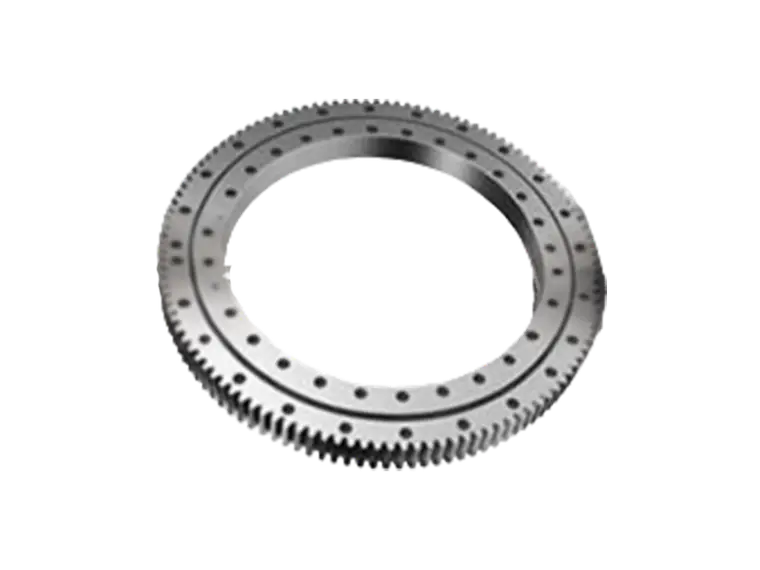
Because preload is a narrow window between too little and too much, the repeatability of the bearing itself becomes a quality issue. Raceway geometry, roller sorting and assembly control determine whether a supplied light preload grade behaves the same way in unit one and unit one thousand. Working with a manufacturer that controls these variables, such as PRS, allows a design to be released with confidence that the specified condition will be reproduced in production rather than only in the prototype.
Frequently Asked Questions
Can a clearance bearing be converted to preload later?
Often yes, if the mounting design includes adjustable spacers or a locking nut. The bearing must be capable of operating in the preloaded condition without excessive contact stress, which is best confirmed with the manufacturer.
Does higher preload always mean better accuracy?
No. Preload improves stiffness and repeatability up to a point, but excess preload increases heat and friction, which can degrade accuracy through thermal distortion and shorten bearing life.
How do I know if my preload is too high?
Typical signs are elevated running temperature, higher drive current than expected at low speed, and a noticeable increase in starting torque. These should be investigated before the bearing is run for extended periods.
Is preload affected by operating temperature?
Yes. Steel expands with heat, and if the inner ring runs hotter than the outer ring, preload increases during operation. High-speed or high-temperature applications may require light preload or a compensating mounting design.
Preload and clearance are not quality labels but design decisions. Clearance keeps friction and heat low at the cost of stiffness; preload delivers rigidity and repeatability at the cost of torque and thermal sensitivity. The correct choice comes from the accuracy the axis must hold, the loads it must carry, and the thermal conditions it will see. Once that requirement is defined, the remaining work is to specify a standard grade and set it accurately during assembly, with a supplier who can reproduce it consistently.