

Selecting a crossed roller bearing rarely comes down to size or load capacity alone. The accuracy grade — commonly written as P0, P6, P5, P4, or P2 — determines how precisely the bearing rotates, how much runout it contributes, and how well it holds position over time. Choose a grade that is too loose and the machine's motion performance suffers. Choose one that is unnecessarily tight and you pay for precision the application cannot use. This guide breaks down what the grades actually mean, which parameters define them, and how to match a grade to a real application.
What Bearing Accuracy Grades Actually Define
An accuracy grade is not a single measurement. It is a standardized set of tolerances applied to specific geometric characteristics. The most widely referenced standards are ISO 492, DIN 620, and JIS B 1514, all of which use the same grade designations: P0 (normal), P6, P5, P4, and P2 (highest precision). P2 is the tightest, P0 the most relaxed.
For crossed roller bearings, these grades primarily control:
- Radial runout of the inner ring (Kia)
- Radial runout of the outer ring (Kea)
- Face runout of the inner ring (Sia)
- Face runout of the outer ring (Sea)
- Parallelism between inner and outer rings
- In some cases, raceway position tolerances
Crossed roller bearing manufacturers generally follow the ISO/JIS system, so P-class designations are standard. ABEC classifications (ABEC 1, 3, 5, 7, 9), which come from ABMA and apply to imperial radial ball bearings, are sometimes referenced in comparison tables but are not a direct substitute because the geometry and load path of a crossed roller bearing are fundamentally different.
Why Crossed Roller Bearings Demand Special Consideration
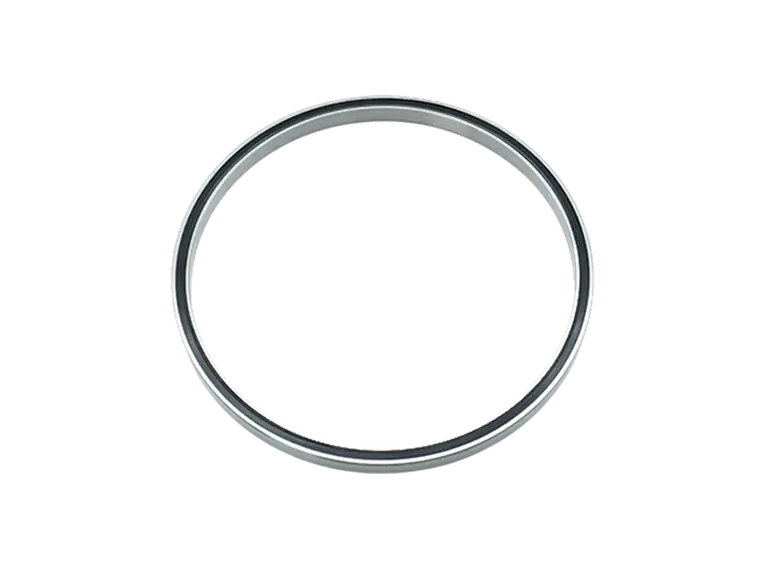
Crossed roller bearings use cylindrical rollers arranged in an alternating perpendicular pattern within the raceway, rather than balls. This arrangement delivers high rigidity and a compact cross-section, but it also means that precision deviations translate more directly into motion error. A given amount of runout produces a larger angular deviation in a crossed roller bearing than it would in a ball bearing of the same grade, because the rollers contact the raceway along a line rather than at a point.
As a result, the practical impact of a tolerance class is often greater for a crossed roller bearing than for a deep groove ball bearing. A P5 crossed roller bearing may be entirely appropriate for a robot joint, while the same nominal grade in a ball bearing might not deliver the same positioning repeatability.
The Common Precision Grades and What They Cost You
P0 — Standard Grade
Suitable for general industrial use where rotational accuracy and positioning precision are not critical. Typical applications include conveyor systems, simple indexing mechanisms, and non-critical positioning where cost matters more than tolerance. Tolerances are comparatively loose and unit cost is the lowest.
P6 — Improved Grade
A step tighter than P0. Often found in moderate automation, packaging machinery, and equipment where vibration control is more important than strict positioning. The cost increase over P0 is usually modest.
P5 — Precision Grade
This is the practical starting point for many mid-to-high-end applications: robot joints, CNC indexing tables, medical imaging equipment, and semiconductor handling mechanisms. Runout tolerances are tight enough to support repeatable positioning without the cost premium of higher grades.
P4 — High Precision Grade
Used where accuracy demands are elevated, such as five-axis machining centers, precision metrology equipment, and wafer processing stages. Raceway and roller geometry must be held to tighter limits, which increases grinding time, inspection cost, and typically lead time.
P2 — Ultra Precision Grade
The highest grade, reserved for applications such as metrology instruments, astronomical telescope drives, and high-end optical manufacturing. Tolerances are measured in fractions of a micron, and both manufacturing cost and delivery lead time rise sharply.
How to Choose the Right Grade for Your Application
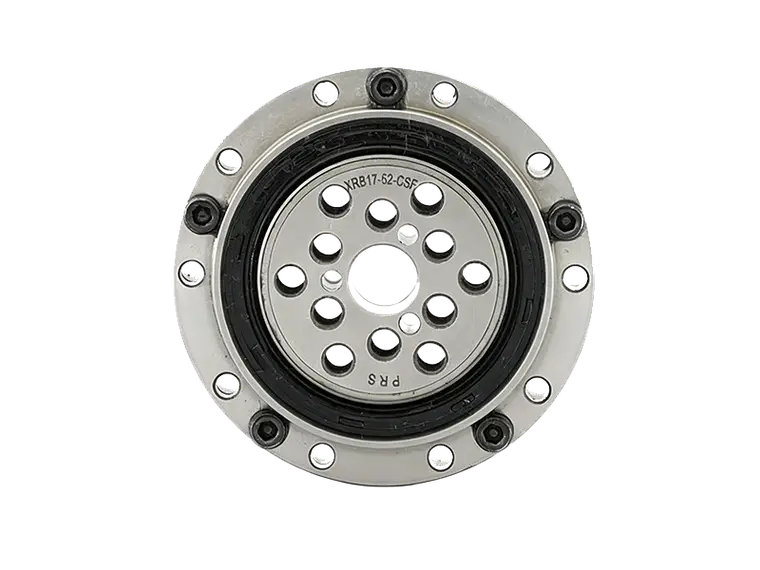
Rather than defaulting to the highest grade available, work from the application backward. A practical approach looks like this:
- Define the permissible positioning error of the equipment under load.
- Determine how much of that error budget belongs to the bearing versus structure stiffness, thermal drift, or the drive system.
- Select a bearing grade whose runout contribution is comfortably below that share of the budget.
- Only escalate to a higher grade if the remaining tolerances still cannot be met.
Escalating a grade comes with real costs — higher unit price, longer lead times, and sometimes tighter requirements for the mounting surface. A P4 bearing installed on a housing that cannot support it will not improve accuracy over a P0 bearing.
Practical Factors That Are Often Overlooked
- Mounting surface flatness and parallelism interact directly with the bearing grade. No amount of bearing precision compensates for an uneven housing.
- Preload condition changes effective accuracy. Proper preload removes clearance and increases stiffness, but excessive preload raises friction and heat, which can degrade precision rather than improve it.
- Lubrication and thermal management can matter more than the grade itself. A P4 bearing running hot may deliver worse real-world accuracy than a P5 bearing operating at a stable temperature.
- Measurement conditions matter. Runout values are defined under specific measurement loads, and figures from different data sheets are not always directly comparable without confirming the measurement basis.
Where Manufacturing Quality Determines the Grade
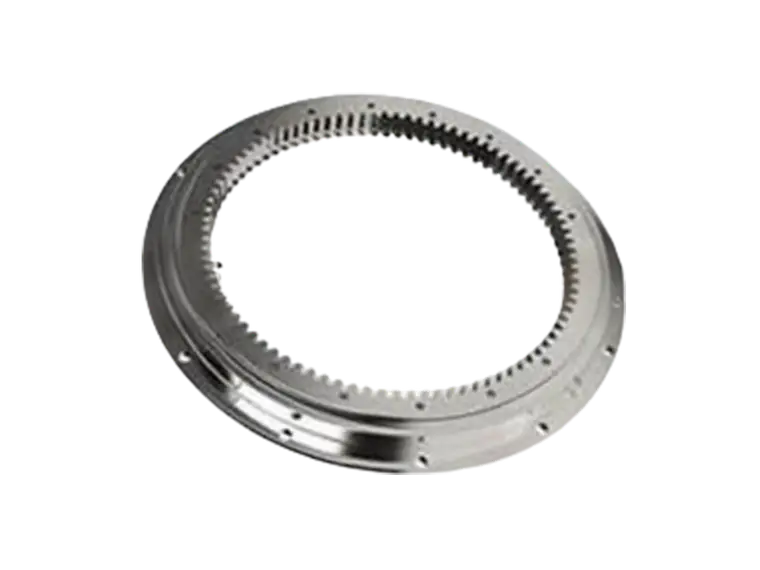
Accuracy grades are not simply sorted from a single production line. They reflect the manufacturing process itself: raceway grinding and lapping, roller sorting and matching, assembly environment, and measurement discipline. A facility capable of P2 work has typically invested in heat treatment stability, clean assembly, and metrology equipment that also benefits lower grades in the same production line — though less visibly.
PRS produces crossed roller bearings across multiple precision grades, focusing on raceway geometry control and batch-to-batch consistency rather than isolated best-case samples. When you need repeatable positioning rather than occasional peak performance, consistency between units often matters more than any single tolerance number on a data sheet.
FAQ
Is a higher grade always better?
No. Higher grades carry tighter tolerances and higher cost. If the application's error budget is dominated by other factors, upgrading from P5 to P4 or P2 will not meaningfully improve performance.
Does P5 always equal ABEC 5?
Not strictly. The two systems define different sets of geometric tolerances and apply to different bearing types. It is better to compare the specific parameters being measured than to assume a one-to-one grade correspondence.
Can I mix grades in the same assembly?
Occasionally — for example, using different grades at opposite ends of a spindle — but only when the error budget is carefully analyzed. Mixing grades without analysis introduces accuracy inconsistencies that are difficult to trace.
Summary
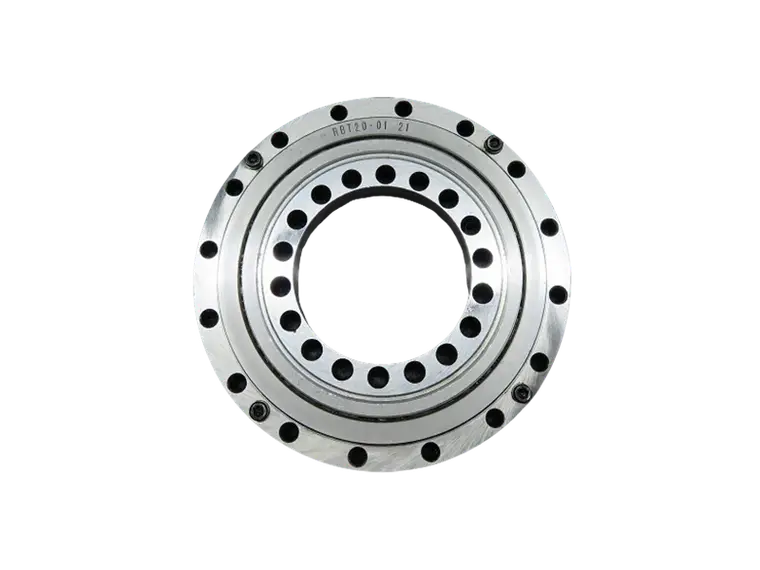
Crossed roller bearing accuracy grades are a vocabulary for describing exactly how precise a bearing will be under real operating conditions. Understanding what each grade controls, where the cost comes from, and how much error the surrounding machine can tolerate lets you specify the right grade without paying for precision the application will never use.