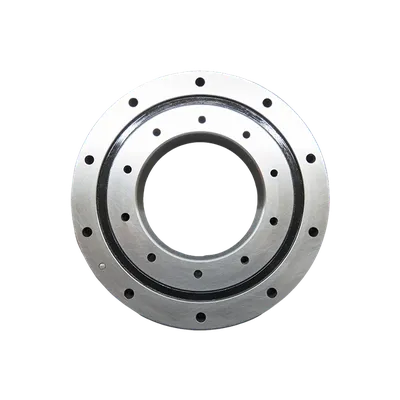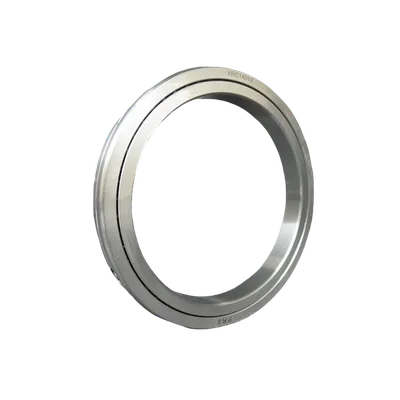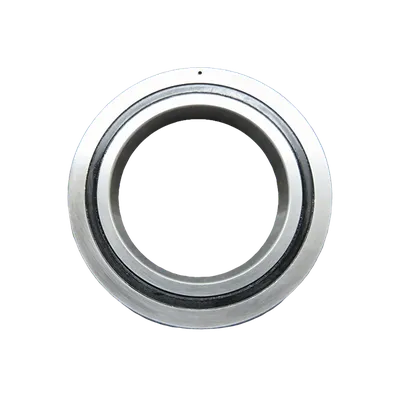

Crossed roller bearings are built for the tight spaces and heavy demands of precision rotary tables, robot joints, indexing heads, and gear reducers. Their rollers are arranged at 90 degrees to one another in a single wide raceway, and that design concentrates load, reduces deflection, and leaves very little internal clearance for lubricant to circulate. As a result, the lubrication decision carries more weight than in an ordinary ball bearing. The wrong grease, an incorrect fill volume, or a missed relubrication interval will show up as rising torque, elevated running temperature, and eventual raceway spalling. This guide covers lubricant function, grease versus oil selection, quantity, relubrication intervals, and the application errors that shorten bearing life.
What Lubrication Actually Does Inside a Crossed Roller Bearing
Lubricant is not simply there to make things slippery. In a crossed roller bearing, it performs several jobs at once, and each one matters for accuracy as much as for life.
- Film separation: A hydrodynamic or elastohydrodynamic film keeps roller surfaces and raceways apart under load, preventing metal-to-metal contact that leads to micropitting and wear.
- Friction and torque control: Consistent film thickness keeps starting and running torque predictable, which is critical in servo-driven positioning axes.
- Heat transfer: Lubricant carries frictional heat away from the contact zones. Crossed roller bearings typically have limited space for this, so circulation matters.
- Corrosion protection: Moisture and acidic residues attack polished raceways quickly. Additives in the lubricant form a protective layer.
- Contamination exclusion: A well-packed grease cavity helps block fine particles and cutting fluid from entering the raceway.
Because the rollers cross and the cage pockets are narrow, lubricant distribution is rarely uniform. That makes both the type and the quantity of lubricant more sensitive than in simpler bearing designs.
Grease or Oil: Matching the Lubricant to the Application
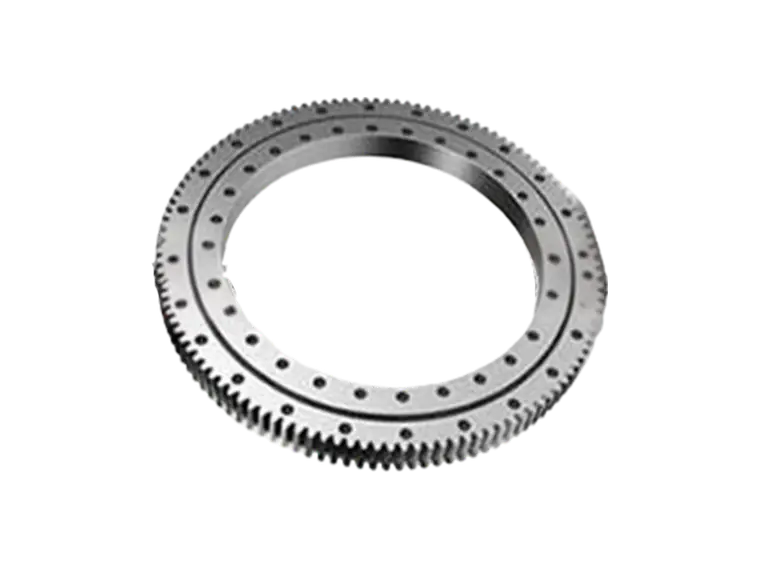
Most cross roller bearing installations end up on grease, but oil remains the correct choice in specific cases. The decision should follow speed, thermal load, sealing, and maintenance access.
When grease is the right choice
Grease stays in place, requires simpler sealing, and supports long intervals between service. It suits low to moderate speeds, sealed or well-enclosed housings, and applications where maintenance access is difficult. For bearings with integral seals, grease is usually the only practical option because oil cannot be retained.
When oil is the right choice
Oil removes heat far better than grease and reaches contact zones more reliably at high speed. It is preferred for continuous high-speed rotation, heavy thermal load, or where an oil circulation system already exists in the machine. The trade-off is more complex sealing, more frequent inspection, and higher sensitivity to contamination.
- Speed: High speed and high heat favor oil; moderate speed favors grease.
- Sealing: Open, well-sealed housings can use either; sealed bearings are limited to grease.
- Orientation: Vertical or tilting axes retain grease more reliably.
- Maintenance access: Inaccessible locations favor grease with a long service life.
- Environment: Washdown or humid areas require greases with strong water resistance and corrosion inhibitors.
Selecting the Right Grease Specification
Not every general-purpose bearing grease is suitable. Crossed roller bearings combine slow-to-moderate speeds with high radial, axial, and moment loads, so the grease needs a robust base oil and a stable thickener.
Base oil viscosity
Base oil viscosity should be chosen from the operating speed and load rather than copied from a general chart. As a practical starting point for many precision crossed roller applications, base oils in the range of roughly 100 to 220 cSt at 40 degrees Celsius provide a workable film at moderate speeds. Higher loads and lower speeds push toward the upper end; higher speeds push toward the lower end to limit churning heat.
Thickener type and consistency
Lithium complex, polyurea, and calcium sulfonate thickeners are all used successfully. NLGI grade 2 is the common default; grade 1 is preferred for lower starting torque and lower temperature operation. Thickener compatibility must be checked before any change, since mixing incompatible greases can soften the structure and cause the lubricant to leak or channel.
Additives
Extreme pressure and anti-wear additives help under high load. For precision positioning axes, keep solid additives such as molybdenum disulfide or PTFE to a minimum unless boundary lubrication conditions genuinely exist, because they can raise running torque. Corrosion inhibitors and oxidation stability matter in every case.
Suppliers such as PRS typically publish recommended lubricant grades, fill volumes, and service intervals for each bearing series. Those recommendations should always take precedence over generic guidance when they are available.
How Much Lubricant and How Often
Fill volume and relubrication interval are the two parameters most often handled incorrectly, and both have a direct effect on temperature.
Fill volume
Grease should occupy part of the free internal space, not all of it. A common range is 30 to 50 percent of the free cavity for low-speed, high-load duty, reduced to around 15 to 30 percent for higher speeds. Overfilling causes churning, heat buildup, and grease migration past the seals. Underfilling leaves contact zones starved during acceleration and reversing cycles, which are common in indexing tables.
Relubrication intervals
Interval depends on speed, load, temperature, and contamination. A widely used rule of thumb is that grease life is roughly halved for every 15 degrees Celsius of operating temperature above about 70 degrees Celsius. Interval should also be shortened in dirty, humid, or high-vibration environments, and extended only where monitoring confirms stable temperature and torque. Bearings that run continuously at high speed with oil circulation require filtration checks rather than a fixed calendar schedule.
Application Procedure and Common Mistakes
Correct technique prevents most lubrication-related failures. A workable sequence for grease-packed bearings looks like this:
- Work in a clean area and keep tools, gloves, and lubricant containers free of debris.
- Remove the preservative oil or shipping lubricant with a compatible solvent and dry the bearing thoroughly.
- Inspect raceways, rollers, and seals for corrosion, dents, or damage before lubrication.
- Apply grease with a metered gun, working it into the roller path and cage pockets rather than packing only the outer cavity.
- Rotate the bearing slowly to distribute the lubricant evenly.
- Run in at low speed and monitor temperature. It should stabilize; a steady climb signals overfilling or the wrong grease.
Errors that repeatedly cause problems include:
- Mixing greases with incompatible thickeners during top-up.
- Adding fresh grease without purging old, oxidized lubricant from the cavity.
- Using a high-viscosity grease on a high-speed axis and then blaming the bearing for heat.
- Ignoring shelf life; most greases degrade in storage and should be used within the stated period.
- Running unsealed bearings in wet or dusty environments without a purge or barrier arrangement.
Frequently Asked Questions
Can I switch from grease to oil on an existing crossed roller bearing?
Only if the bearing is unsealed and the housing can be modified to retain and drain oil. Sealed bearings cannot be converted. Flush the bearing thoroughly before switching to remove all old grease.
How do I know if the bearing has too much grease?
Rising running temperature that does not stabilize within the first hour of operation, together with grease weeping past the seals, is the usual sign. Reducing fill volume and re-running normally resolves it.
Does a slower application always mean longer life?
No. Starved contacts cause adhesive wear and surface distress long before a properly lubricated bearing reaches its calculated life. Film thickness matters more than lubricant quantity in the contact zone.
Closing Notes
Lubrication of a crossed roller bearing is a specification decision, not an afterthought. Confirm the lubricant grade and fill volume against the bearing manufacturer's documentation, match the base oil viscosity to the actual speed and load, shorten intervals where temperature or contamination demands it, and verify results through temperature and torque monitoring. For application-specific guidance on lubricant selection and relubrication scheduling, PRS can advise on the correct approach for each bearing series.