

Manufactured by PRS Bearings, the PC30008 is a precision C Type Radial Contact Ball Bearing. You may consider it as an interchangeable alternative and replacement for KAYDON K30008CP0. Key dimensional parameters include a 300 mm bore diameter, a 316 mm outer diameter, and a mm overall width. With matching boundary dimensions, this component is designed to meet standard load requirements and ensure consistent operational performance. For comprehensive technical evaluation, please explore the detailed specifications, dimensional data, product images, and CAD drawings provided below. A complete PDF data sheet is also readily available for direct download to support your engineering and procurement needs.
PC30008 - C Type Radial Contact Ball Bearing
Technical Specifications
| Direct Interchange | KAYDON K30008CP0 |
|---|---|
| Overview | |
| Basic Model | PC30008 |
| Weight | 0.35 kg |
| Dimensions | |
| Bore Dia (d, mm) | 300 mm |
| Outer Dia (D, mm) | 316 mm |
| Load Ratings | |
| Dynamic Load (Cr) | 949 kN |
| Static Load (Cor) | 3055 kN |
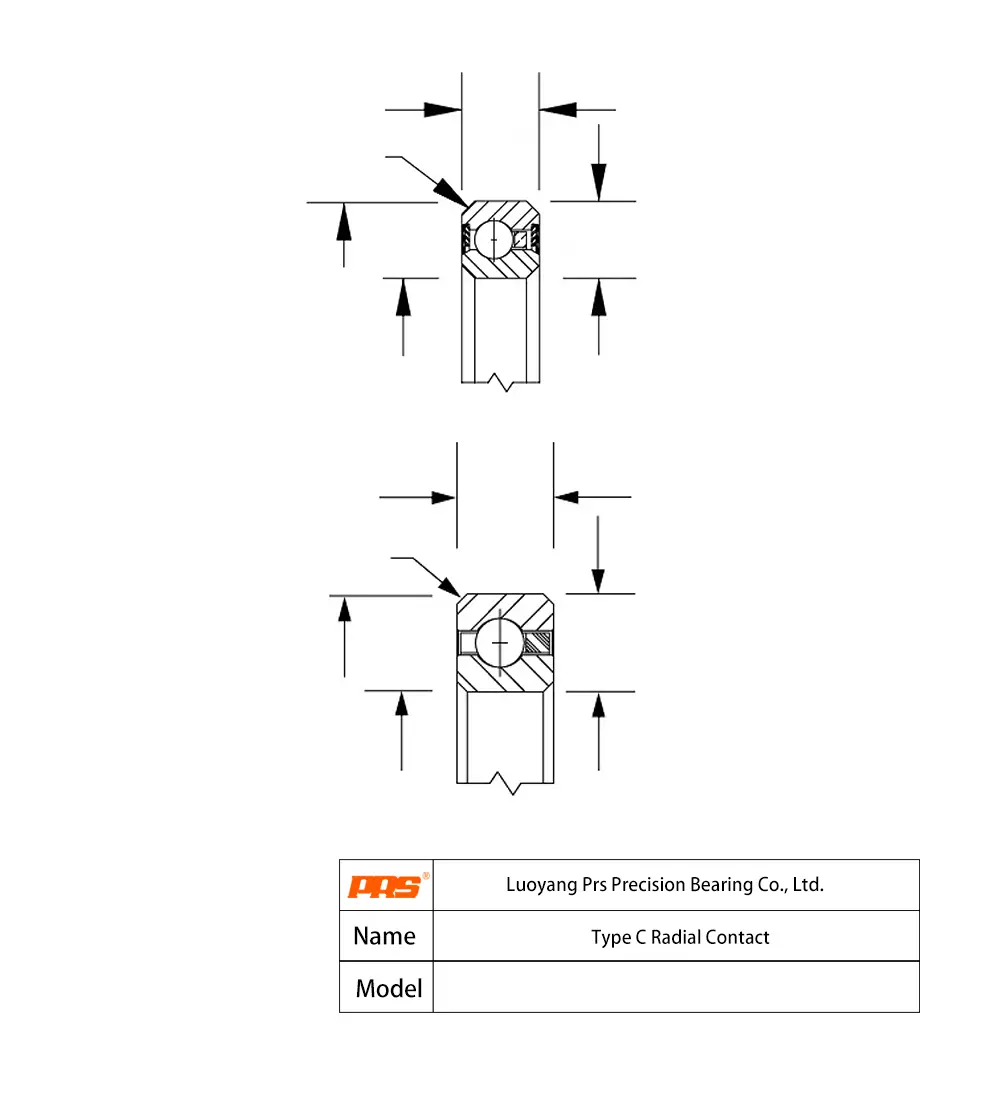 316 mm 316 mm 300 mm 300 mm PC30008
 Frequently Asked Questions about PC30008 C Type Radial Contact Ball Bearing
Find key technical answers regarding dimensions, specifications, and replacement options for this model.
The standard PC30008 from PRS Bearings is heat-stabilized for temperatures up to 120°C. For extreme heat applications, PRS Bearings offers custom S1 or S2 stabilization treatments to ensure the component maintains its 300 mm x 316 mm dimensions without warping.
PRS Bearings recommends storing the PC30008 in its original packaging in a clean, low-vibration warehouse. Maintaining a relative humidity below 60% and a stable room temperature ensures maximum shelf life.
Yes, while the standard PRS Bearings PC30008 meets ISO P0 (ABEC-1) levels, PRS Bearings also manufactures high-precision variants in P6 (ABEC-3) and P5 (ABEC-5) for applications requiring minimal runout and extreme rotational accuracy.
Absolutely. The precise manufacturing of the PRS Bearings PC30008 results in stable, predictable vibration baselines. This makes it highly compatible with modern IoT condition monitoring sensors for early fault detection.