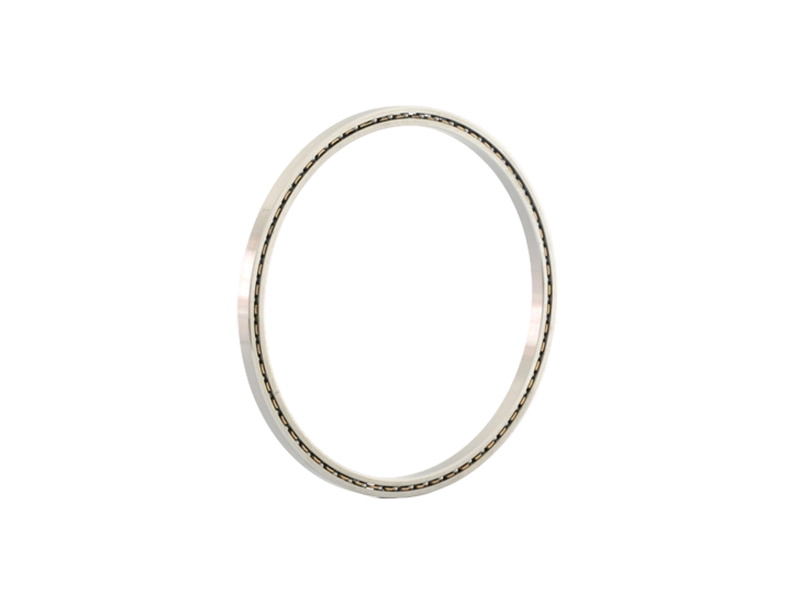
Why Compact Robot Arms Need Crossed Roller Bearings
2026-06-01 02:39:52PRS Bearings
The push toward miniaturization in automation has placed unprecedented demands on robot arm design. Smaller, lighter, and faster—these compact robot arms must maintain exceptional precision and stiffness while operating in increasingly tight spaces. At the heart of this engineering challenge lies a critical component: the bearing. Traditional ball bearings often fall short in meeting the combined requirements of high moment load capacity, axial rigidity, and rotational accuracy within a limited envelope. This is why crossed roller bearings have become the go-to solution for compact robot arm joints, and understanding their unique advantages is essential for any engineer seeking optimal performance.
What Makes Compact Robot Arms Different from Industrial Giants
Compact robot arms—often used in collaborative robots, medical devices, and laboratory automation—operate under fundamentally different constraints than their larger counterparts. The reduction in size does not proportionally reduce the demands on the bearing system.
- Higher acceleration and deceleration: Smaller arms cycle faster, producing larger dynamic loads.
- Greater moment load sensitivity: With a shorter lever arm, off-axis forces generate proportionally higher stresses on the bearing raceway.
- Tighter integration: The bearing must fit into a smaller housing while supporting radial, axial, and moment loads simultaneously.
- Precision requirements: Repeatability in sub-arcminute ranges is common, demanding minimal clearance and high stiffness.
These factors directly influence the bearing selection. A bearing that works well in a large industrial arm may fail prematurely in a compact design due to insufficient rigidity or excessive clearance.
Crossed Roller Bearings: The Engineering Answer
A crossed roller bearing consists of cylindrical rollers arranged in a cross pattern between inner and outer rings. Each roller alternates orientation by 90 degrees, creating a structure that can handle axial loads from both directions, radial loads, and moment loads with a single row of rolling elements. This design offers distinct mechanical advantages.
Superior Rigidity Under Moment Loads
The crossed arrangement of rollers ensures that load paths are constantly shared across multiple contact points. When a moment is applied—common in robot arm joints—the rollers on one side take the compressive load while the opposite side handles the tensile load, all within the same compact envelope. This results in a moment rigidity that can be 3 to 5 times higher than an equivalently sized ball bearing, reducing deflection and improving positioning accuracy.
Space and Weight Efficiency
Compact robot arms have no room to spare. Crossed roller bearings allow designers to achieve high load capacity and stiffness without increasing the bearing cross-section. Because they combine multiple load-carrying capabilities in a single row, they eliminate the need for separate bearings or complex preload systems. This directly contributes to a lighter, shorter joint assembly.
Excellent Rotational Accuracy and Smoothness
The cylindrical roller geometry provides line contact instead of point contact, reducing Hertzian stress and distributing loads more evenly. This leads to lower elastic deformation under load and more consistent torque output, both critical for precise trajectory control. Furthermore, the minimal clearance inherent in crossed roller bearings enhances repeatability over the life of the robot.
Comparative Analysis: Crossed Roller vs. Conventional Bearings
To fully appreciate the necessity of crossed roller bearings in compact robot arms, consider how they stack up against common alternatives.
| Parameter |
Crossed Roller Bearing |
Deep Groove Ball Bearing |
Angular Contact Ball Bearing (paired) |
| Moment rigidity |
High (single row) |
Low |
Moderate (requires two rows) |
| Axial rigidity |
Very high |
Low |
High (but dual bearing needed) |
| Space utilization |
Excellent (single row) |
Good |
Poor (needs paired sets) |
| Running accuracy |
Excellent (P2 grade achievable) |
Moderate |
Good |
| Weight |
Low |
Lowest |
Higher (two bearings) |
For compact robot arms, the combination of high moment rigidity and compact single-row design gives crossed roller bearings a clear edge. While ball bearings may suffice for simple rotary motions, they cannot match the multi-axis load handling required in an articulated joint.
PRS Crossed Roller Bearings: Engineered for Automation
PRS specializes in the design and manufacture of crossed roller bearings specifically optimized for robotic applications. Our bearing series incorporate features that address the unique challenges of compact robot arms:
- Integrated mounting flanges – reduce assembly complexity and improve concentricity.
- Custom preload options – match the desired stiffness vs. friction trade-off for each joint.
- High-performance steel or ceramic rollers – for extended life under heavy cycling.
- Sealed or shielded options – protect against contamination in cleanroom or harsh environments.
By working with PRS engineers early in the design phase, robot manufacturers can tailor the bearing clearance, mounting arrangement, and lubrication to achieve maximum service life and accuracy.
Selection Criteria for Crossed Roller Bearings in Compact Arms
Choosing the right crossed roller bearing involves more than just checking load ratings. Consider the following factors to ensure optimal performance:
- Moment load spectrum: Analyze the robot arm's full range of motion to determine the maximum overturning moment. Bearing catalogs typically provide dynamic and static moment ratings.
- Preload class: A light preload reduces clearance and improves stiffness but increases friction. For precision positioning, medium preload is standard.
- Speed and lubrication: Compact arms often run at high rotational speeds—grease selection and sealing must prevent heating and wear.
- Mounting surface tolerances: Bearing ring deflection from non-flat housing surfaces can degrade accuracy. Specify flatness and parallelism within microns.
- Environmental conditions: Temperature, humidity, and particulate matter influence material choice (stainless steel, hybrid ceramics) and sealing.
Proper selection extends bearing life and maintains the sub-arcminute repeatability essential for modern automation tasks such as pick-and-place, assembly, and surgery.
Conclusion
The compact robot arm market demands components that deliver high stiffness, precise motion, and minimal volume under challenging dynamic loads. Crossed roller bearings fulfill these requirements uniquely through their crossed roller geometry, offering moment rigidity and accuracy that conventional ball bearings cannot match in a single-row package. As automation continues to shrink in size while increasing in performance, the role of the crossed roller bearing becomes not just advantageous, but necessary. For engineers seeking reliable, high-precision joint solutions, PRS provides application-specific crossed roller bearings that meet the rigorous demands of next-generation robotic systems.


 XRT Series Crossed Tapered Roller Bearings
 XV Series Crossed Cylindrical Roller Bearing
 XRU Crossed Roller Bearings
 XRSU Crossed Roller Bearings
 XRE Crossed Roller Bearings
 XRC Crossed Roller Bearings
 XRBH Crossed Roller Bearings
 XRB Crossed Roller Bearings
 Ultra Thin XRBS Crossed Roller Bearings
 Ultra Thin XRA-C Crossed Roller Bearings
 Ultra Thin XRA Crossed Roller Bearings
 XRBC Crossed Roller Bearings