Can Crossed Roller Bearings Replace Traditional Slewing Rings?
2026-07-06 02:39:34PRS Bearings
The question of whether crossed roller bearings can replace traditional slewing rings is not a simple yes or no. As rotary motion components, both serve critical roles in machinery that requires smooth, precise rotation under load — from construction cranes and wind turbines to medical scanners and robotic arms. However, their design philosophies and performance characteristics differ significantly. To determine substitutability, engineers must evaluate factors such as load type, accuracy requirements, space constraints, and operating environment. This article provides a detailed technical comparison, helping you assess when a switch makes sense and when traditional slewing rings remain the superior choice.
1. Understanding Crossed Roller Bearings and Traditional Slewing Rings
What Is a Crossed Roller Bearing?
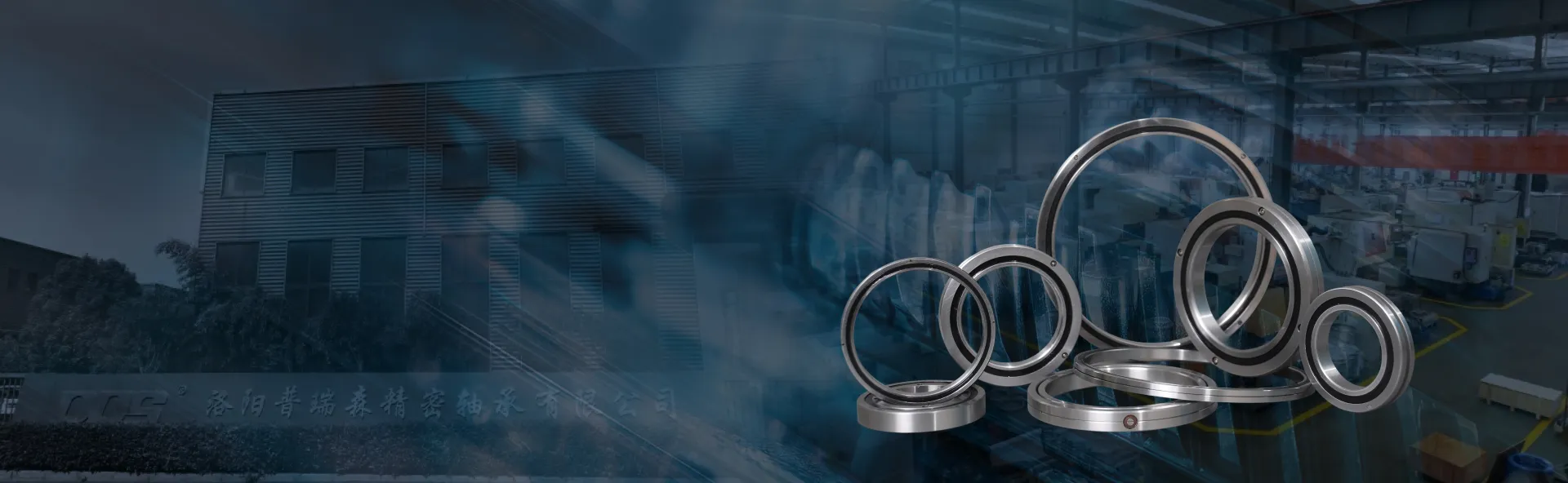
Crossed roller bearings feature cylindrical rollers arranged in a crisscross pattern between inner and outer rings. This design allows them to simultaneously handle radial, axial, and moment loads with high rigidity and precision. The rollers are separated by spacers, reducing friction and enabling smooth rotation at high speeds. Typical applications include machine tool tables, industrial robots, and precision indexing devices.
What Is a Traditional Slewing Ring?
Traditional slewing rings — also called slewing bearings or turntable bearings — typically use single or double rows of balls or rollers in a raceway. They are designed to support heavy axial loads, radial loads, and tilting moments in large, slow-rotating structures. These bearings often integrate integral gears for direct drive and are common in excavators, cranes, and wind turbine yaw systems.
2. Key Comparison: Performance and Application Differences
The following table summarizes the critical distinctions that drive replacement decisions:
- Load Capacity: Traditional slewing rings generally excel in handling extreme axial and moment loads, especially in large diameter sizes. Crossed roller bearings offer high load capacity relative to their compact size but may not match the absolute capacity of a slewing ring designed for multi-ton loads.
- Precision & Rigidity: Crossed roller bearings provide superior rotational accuracy and stiffness due to the line contact of rollers and the preloadable design. Slewing rings, with ball or roller raceways, have inherent play unless specifically engineered for precision.
- Speed & Friction: Crossed roller bearings operate efficiently at higher speeds with lower friction, while slewing rings are optimized for slow, intermittent rotation with high torque transmission.
- Space & Weight: Crossed roller bearings are more compact and lighter for a given load capacity, making them ideal for weight-sensitive applications. Slewing rings tend to have larger cross-sections and higher mass.
- Gear Integration: Many slewing rings include internal or external gear teeth for direct mounting of a pinion. Crossed roller bearings typically do not offer this feature, requiring additional gearing mechanisms if rotation drive is needed.
- Sealing & Environment: Slewing rings are often equipped with robust seals for harsh environments (dust, water, debris). Crossed roller bearings can be sealed but are more commonly used in clean, controlled settings.
3. Can Crossed Roller Bearings Replace Traditional Slewing Rings? A Scenario-Based Analysis
When Replacement Is Feasible
- High-Precision Rotary Tables: In machine tools or inspection equipment where angular accuracy is critical, crossed roller bearings outperform standard slewing rings. Their low runout and high rigidity make them ideal.
- Compact Robotics: For robotic joints requiring high stiffness in a small envelope, crossed roller bearings are often the better choice, especially when rotational speed is moderate to high.
- Light-to-Medium Duty Applications: Some material handling or positioning systems that do not involve extreme loads or harsh environments can benefit from the reduced weight and maintenance of crossed roller bearings.
When Traditional Slewing Rings Remain Necessary
- Heavy Construction Machinery: Excavators and mobile cranes demand extremely high moment and axial load capacities, often exceeding what crossed roller bearings can economically provide. The integrated gear ring also simplifies power transmission.
- Large Wind Turbines: Yaw and pitch slewing rings must endure constant cyclic loads, extreme weather, and minimal maintenance intervals. Proven slewing ring designs with hardened raceways and large diameter cross-sections are standard.
- Applications Requiring Through-Bore or Hollow Shaft: Slewing rings naturally have large central openings for cabling or hydraulic lines. While crossed roller bearings can be made with bores, the cost and complexity increase significantly for large diameters.
4. PRS’s Expertise in Bearing Solutions
With over a decade of specialization in precision rotary components, PRS offers a comprehensive range of both crossed roller bearings and traditional slewing rings. Our engineering team works closely with clients to evaluate load profiles, environmental conditions, and lifecycle costs. Whether you are upgrading a precision stage or designing a heavy-duty turntable, PRS provides application-specific guidance and custom manufacturing capabilities. We do not promote a one-size-fits-all answer; instead, we deliver data-driven recommendations that optimize performance and reliability.
5. Conclusion: Making the Right Choice for Your Application
Crossed roller bearings can replace traditional slewing rings in applications where precision, compactness, and moderate load capacity take priority. However, for extreme loads, integrated gear drives, or harsh environments, conventional slewing rings remain the proven solution. The decision ultimately hinges on a thorough analysis of your specific requirements — load magnitude, rotation speed, accuracy needs, and operating conditions. Consult with experienced suppliers like PRS to evaluate trade-offs and validate your design with simulation or testing. By understanding the strengths and limitations of each technology, you can select the bearing that delivers optimal performance and cost efficiency for your machinery.


 XRT Series Crossed Tapered Roller Bearings
 XV Series Crossed Cylindrical Roller Bearing
 XRU Crossed Roller Bearings
 XRSU Crossed Roller Bearings
 XRE Crossed Roller Bearings
 XRC Crossed Roller Bearings
 XRBH Crossed Roller Bearings
 XRB Crossed Roller Bearings
 Ultra Thin XRBS Crossed Roller Bearings
 Ultra Thin XRA-C Crossed Roller Bearings
 Ultra Thin XRA Crossed Roller Bearings
 XRBC Crossed Roller Bearings