Achieve Sub-Arc-Second Accuracy with Crossed Roller Bearing
2026-06-15 02:39:45PRS Bearings
Achieving sub-arc-second accuracy in rotational motion is the defining challenge for engineers designing the next generation of precision equipment—from wafer handling robots to goniometric stages used in synchrotron beamlines. Traditional bearing technologies often fall short due to inherent clearance, compliance, or kinematic errors. Crossed roller bearings have emerged as the mechanical foundation that makes sub-arc-second positioning not just possible, but repeatable and reliable. This article examines the engineering principles behind this performance, compares crossed roller bearings with other precision bearing types, and illustrates how PRS’s design expertise helps customers reach the 0.1 arc-second threshold in real-world applications.
Understanding Sub-Arc-Second Accuracy and Its Mechanical Hurdles
Sub-arc-second accuracy refers to angular positioning errors smaller than one arc-second (1/3600 of a degree). For a rotary table with a 200 mm diameter, a 0.5 arc-second error corresponds to a linear displacement of roughly 0.5 μm at the circumference. Achieving this level demands bearings with absolute minimum runout, friction variation, and elastic deformation.
Why Conventional Bearings Struggle
Ball bearings rely on point contact, which leads to high Hertzian stresses and noticeable elastic deformation under load. Even preloaded angular contact ball bearings exhibit variations in contact angle and cage instability that produce periodic errors in the sub-arc-second range. Crossed roller bearings, by contrast, use line contact between cylindrical rollers arranged alternately at 90° angles. This geometry provides high stiffness in all radial, axial, and moment loading directions with minimal deflection—a prerequisite for sub-arc-second stability.
The Crossed Roller Bearing Design That Enables Sub-Arc-Second Performance
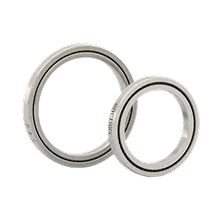
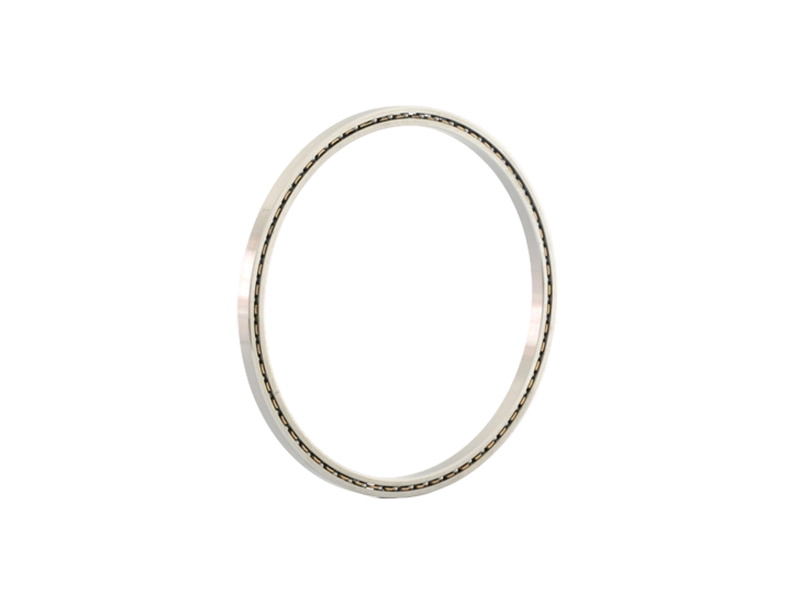
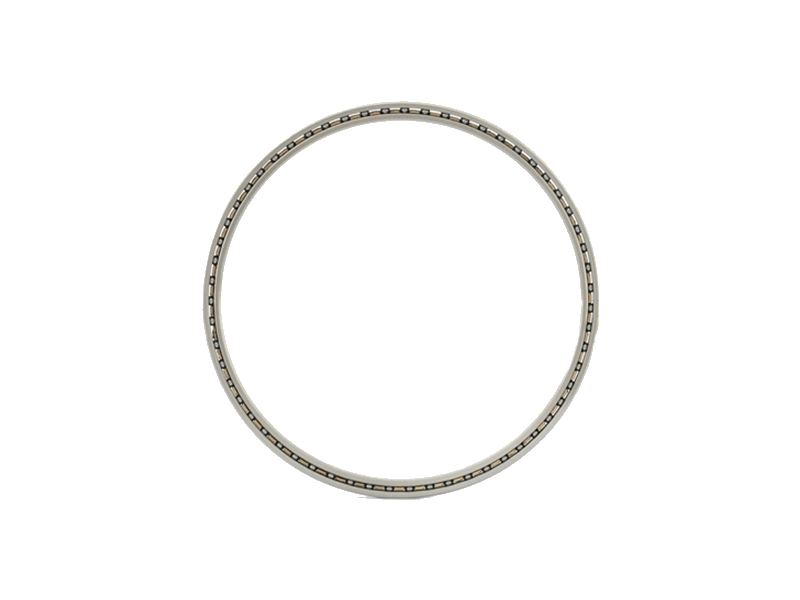
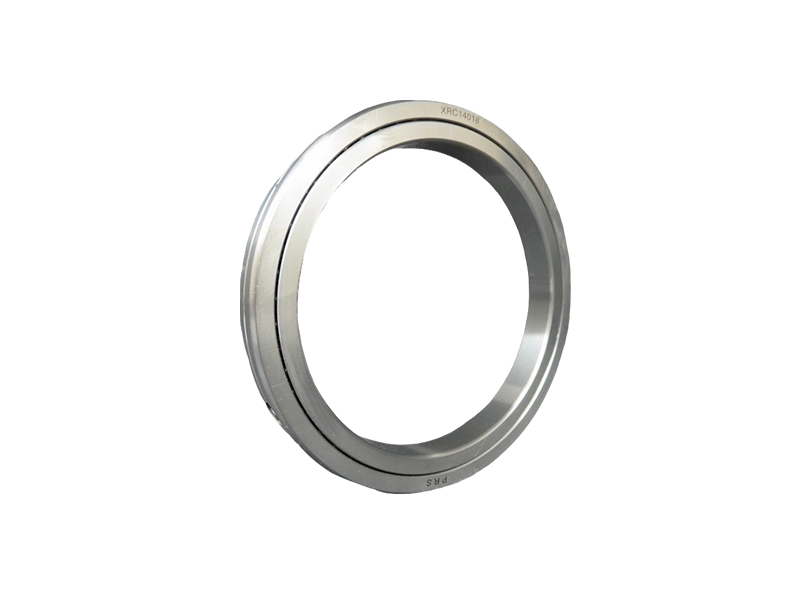
The key design feature of a crossed roller bearing is its roller arrangement: each roller is rotated 90° relative to its neighbor, with a separator (cage) maintaining precise spacing. This orthogonal orientation allows the bearing to absorb combined loads and constrain all degrees of freedom except rotation. When combined with precision-ground raceways and optimized preload, the result is a bearing with virtually zero clearance and highly uniform rolling resistance.
Raceway Geometry and Material Selection
PRS manufactures raceways from vacuum-degassed bearing steel with hardness exceeding HRC 58, then grinds them to surface finish tolerances below Ra 0.05 μm. Raceway roundness is held within 0.5 μm, and roller diameter matching (Grade 3 or better) ensures that each roller carries an equal share of the load. This attention to geometry eliminates the error motions that would otherwise accumulate into arc-second-level inaccuracies.
Preload: The Critical Adjustment
For sub-arc-second applications, PRS applies a controlled preload that removes internal clearance without generating excessive torque. Preload is specified as a function of expected external loads and thermal conditions. Too little preload leaves residual clearance that manifests as lost motion; too much creates friction-induced thermal gradients that distort the raceways. PRS’s preload optimization process uses finite element analysis to deliver a preload that maintains zero clearance under all operating conditions, directly enabling sub-arc-second repeatability.
Comparing Crossed Roller Bearings to Other Precision Bearing Types
To understand why crossed roller bearings are the preferred choice for sub-arc-second accuracy, it is useful to compare their characteristics with other commonly used precision bearings.
Crossed Roller vs. Angular Contact Ball Bearings
| Parameter | Crossed Roller Bearing | Angular Contact Ball Bearing |
|---|
| Contact type | Line contact | Point contact |
| Radial stiffness | Very high | Moderate |
| Moment stiffness | High (both directions) | Moderate (paired arrangement needed) |
| Runout repeatability | < 0.5 μm typical | 1-2 μm typical |
| Friction torque variation | Low and predictable | Higher due to cage interaction |
| Sub-arc-second capability | Achievable with proper design | Difficult beyond 2 arc-seconds |
Crossed Roller vs. Tapered Roller Bearings
Tapered roller bearings offer high load capacity but typically have adjustable axial clearance that varies with temperature. Their conical raceways produce axial forces during operation, complicating preload control. Crossed roller bearings maintain consistent preload independent of thermal expansion direction, making them superior for applications requiring stable sub-arc-second accuracy over a wide temperature range.
Real-World Applications Demanding Sub-Arc-Second Accuracy
The semiconductor industry is one of the most demanding: wafer inspection stages must position wafers to within 0.1 μm linear accuracy, translating to angular errors below 0.3 arc-seconds for a 300 mm wafer. Crossed roller bearings are used in the rotary axes of these stages because they provide the necessary stiffness without introducing unpredictable friction that would degrade servo control.
Another critical sector is astronomy: the altitude-azimuth mounts of large telescopes require bearing assemblies that can track celestial objects with sub-arc-second pointing stability over hours of movement. PRS has supplied custom crossed roller bearings for both telescope altitude axes and Nasmyth platforms, where the combination of low friction, high moment stiffness, and temperature compensation is essential.
Advanced manufacturing—specifically, the positioning of optical components for laser micromachining and lithography—also relies on sub-arc-second rotary tables. In these systems, the crossed roller bearing acts as both the mechanical support and the precision reference, eliminating the need for complex closed-loop compensation that would add cost and latency.
Selecting the Right Crossed Roller Bearing for Sub-Arc-Second Requirements: A PRS Perspective
Choosing a crossed roller bearing for a sub-arc-second application involves more than picking a catalog number. Key parameters to evaluate include:
- Raceway roundness and waviness: Errors below 0.5 μm are mandatory; PRS can achieve 0.3 μm on request.
- Roller grade and material: Grade 3 ceramic or steel rollers with diameter tolerance ±0.13 μm provide uniform load distribution.
- Preload consistency: Specified as a range (e.g., 5-15 N·m starting torque) that ensures zero clearance under all loads.
- Thermal behavior: Coefficient of thermal expansion matching with mating components; PRS offers integral steel housings to minimize mismatch.
- Customization: PRS provides non-standard bore diameters, special mounting flanges, and integrated encoder interfaces to reduce assembly stack-up errors.
PRS engineers work directly with customers to model the bearing’s static and dynamic stiffness using proprietary software. This simulation predicts the effective rotational accuracy under expected loads, allowing the design to be refined before prototype production. In one recent case, PRS helped a metrology company achieve 0.15 arc-second positional repeatability on a 400 mm diameter table by optimizing roller count and preload distribution, exceeding the original specification by 25%.
Conclusion: Linking Design Excellence to Sub-Arc-Second Outcomes
Sub-arc-second accuracy is not a product you can buy off the shelf; it is a system-level achievement in which the crossed roller bearing plays the decisive mechanical role. By combining line-contact rigidity, precision raceway geometry, and controlled preload, these bearings eliminate the error sources that plague other designs. PRS’s deep integration of bearing design with application engineering makes it possible to reach—and maintain—rotational errors below one arc-second in demanding environments. Whether your next project involves semiconductor metrology, telescope control, or ultra-precision machine tools, specifying a PRS crossed roller bearing is the engineering decision that turns the theoretical promise of sub-arc-second accuracy into measurable, repeatable reality.


 XRT Series Crossed Tapered Roller Bearings
 XV Series Crossed Cylindrical Roller Bearing
 XRU Crossed Roller Bearings
 XRSU Crossed Roller Bearings
 XRE Crossed Roller Bearings
 XRC Crossed Roller Bearings
 XRBH Crossed Roller Bearings
 XRB Crossed Roller Bearings
 Ultra Thin XRBS Crossed Roller Bearings
 Ultra Thin XRA-C Crossed Roller Bearings
 Ultra Thin XRA Crossed Roller Bearings
 XRBC Crossed Roller Bearings