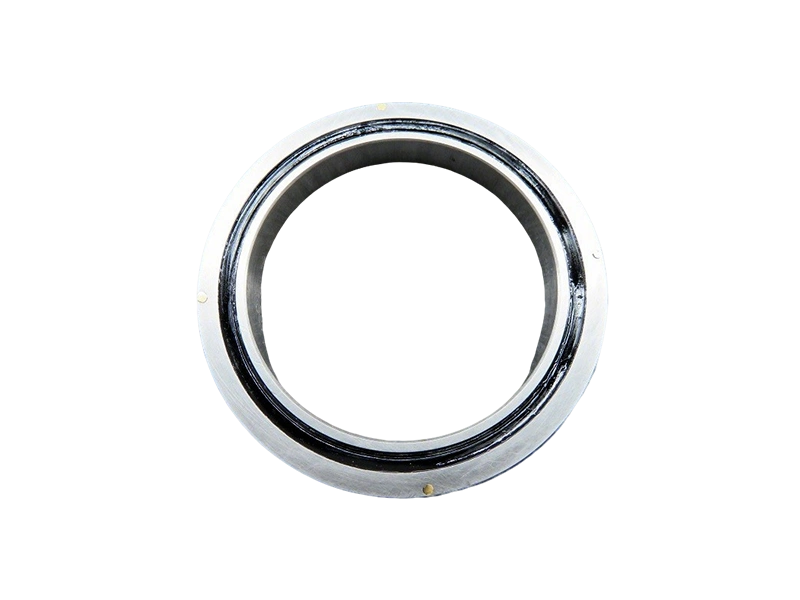
Crossed Roller Bearings: The Key to Ultrathin Rotary Stages
2026-07-28 02:39:33PRS Bearings
Compact, high-performance motion systems increasingly demand rotary stages that are both ultrathin and capable of supporting heavy loads with micron-level accuracy. Traditional bearing designs often compromise between height and stiffness, forcing engineers to accept trade-offs. Crossed roller bearings have emerged as the critical enabler for achieving sub-15 mm stage heights while maintaining exceptional rigidity and smooth motion. For Precision Rotary Solutions (PRS), mastering this bearing technology is the foundation of our ultraflat rotary stage product line. This article explores why crossed roller bearings are the key to ultrathin rotary stages and how they outperform alternatives.
What Are Crossed Roller Bearings?
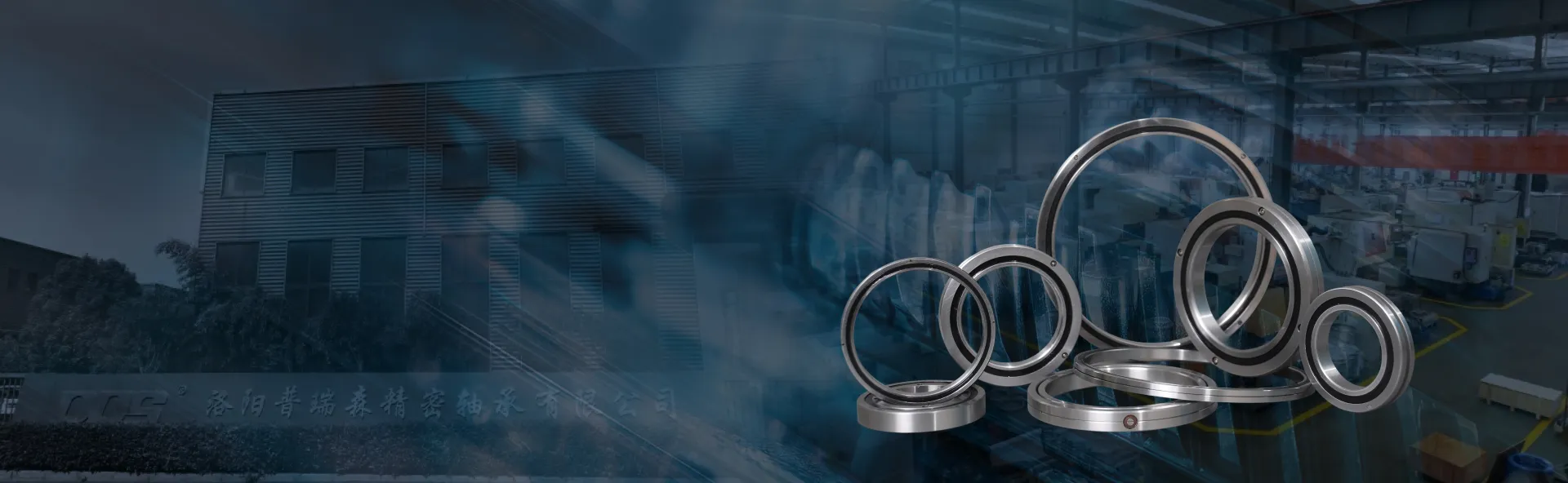
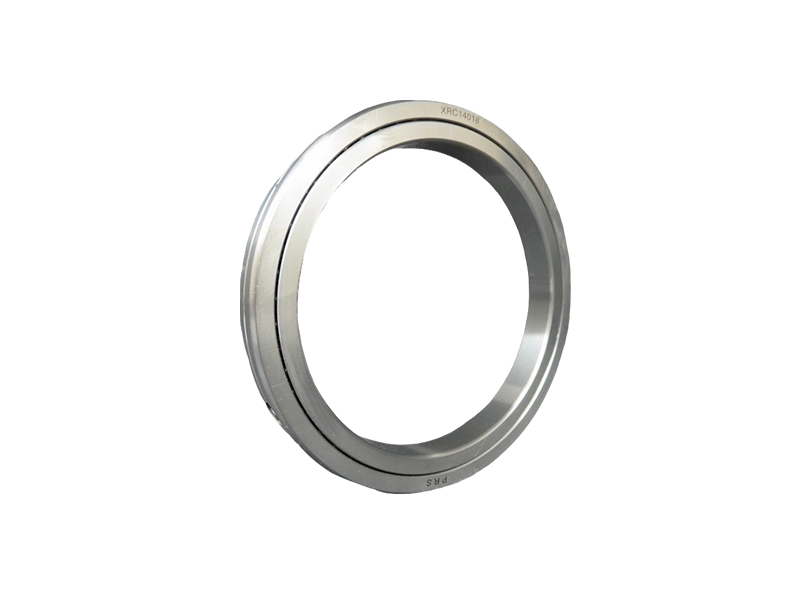
Crossed roller bearings consist of cylindrical rollers arranged alternately at 90-degree angles between inner and outer rings. Unlike standard ball bearings that use point contact, the rollers provide line contact, distributing load over a larger area. This unique configuration allows the bearing to handle axial, radial, and moment loads simultaneously with minimal deflection. The rollers are separated by a retainer (cage) that prevents metal-to-metal contact and ensures smooth rolling. PRS employs precision-ground crossed roller bearings with custom preload settings to meet the specific stiffness and torque requirements of modern rotary stages.
Key Structural Features
- Crossed roller arrangement — Alternating rollers contact the raceways in perpendicular directions, enabling the bearing to support forces from multiple axes in a single housing.
- Compact sectional height — The inherently thin cross-section of the rolling elements allows bearing heights as low as 5 mm, directly contributing to ultrathin stage designs.
- High rigidity — Line contact results in up to 10 times higher stiffness compared to ball bearings of equivalent size, reducing elastic deformation under load.
- Low friction — Precision-ground rollers and raceways minimize sliding friction, enabling smooth rotation with minimal torque fluctuation.
Why Ultrathin Rotary Stages Depend on Crossed Roller Bearings
A rotary stage’s height is often dictated by the bearing stack. Conventional angular contact ball bearings require at least two bearings (often four) to handle combined loads, which inevitably increases stage thickness. Crossed roller bearings eliminate this need: a single bearing can absorb all load directions. This reduction in component count is the primary reason PRS achieves stage heights under 10 mm without sacrificing load capacity. Additionally, the preload can be built directly into the bearing during manufacturing, removing the need for complex shimming or adjustment mechanisms that add height.
Rigidity-to-Height Ratio
In semiconductor wafer inspection, laser processing, and medical positioning systems, every millimeter of stage height matters for system integration. Crossed roller bearings offer the highest rigidity per unit height of any rolling bearing type. For example, a PRS UTR-100 stage (100 mm diameter) uses a crossed roller bearing only 6 mm thick yet supports 200 N axial load with less than 2 arc-seconds of tilt error. This performance is unattainable with ball bearings in the same footprint.
Crossed Roller Bearings vs. Alternative Bearing Technologies
Engineers evaluating bearing options for ultrathin stages must weigh several factors: height, stiffness, torque, and lifetime. The following table summarizes the key differences.
| Feature | Crossed Roller | Deep Groove Ball | Angular Contact Ball (pair) |
|---|
| Section height (for 100mm bore) | 6–9 mm | 10–15 mm | 12–20 mm |
| Axial rigidity | High | Low–Medium | Medium–High |
| Moment load capacity | Excellent (single bearing) | Poor (requires multiple) | Good (requires two) |
| Rotational accuracy | ±0.5 μm runout | ±2 μm typical | ±1 μm |
| Operating life at rated load | Sustained 100+ million cycles | ~30 million cycles | ~50 million cycles |
While crossed roller bearings cost more per unit, the total system cost can be lower because no additional bearings or complex housings are required. For PRS customers, the investment translates into reliable, maintenance-free operation in production environments.
Applications That Benefit from Crossed Roller Rotary Stages
Industries pushing the limits of miniaturization and precision — such as photonics alignment, wafer probing, and 3D printing — increasingly specify crossed roller rotary stages. The advantages are particularly clear in:
- Laser micromachining: High acceleration and deceleration demand bearing stiffness to avoid resonant vibration; crossed rollers provide superior damping.
- Metrology and inspection: Nanometer-level positioning requires minimal runout and tilt error, both delivered by precision-ground crossed roller bearings.
- Medical robotics: Compact, lightweight stages with high payload-to-weight ratio enable portable surgical assist arms.
How PRS Engineers Optimize Crossed Roller Bearing Selection
Not all crossed roller bearings are equal. PRS works closely with bearing manufacturers to specify custom raceway geometry, roller grades, and preload levels suited for rotary stage dynamics. Key considerations include:
- Preload type: Light preload for low-torque scanning; heavy preload for vibration-resistant positioning.
- Lubrication: Grease for moderate speeds, oil mist for high-speed applications, or solid lubricant for vacuum environments.
- Bearing material: Through-hardened bearing steel (SUJ2) for standard environments; stainless steel or ceramic rollers for corrosive or non-magnetic requirements.
- Integration with drive: Direct-drive motors or harmonic drives benefit from the low friction and zero-backlash characteristics of crossed roller bearings.
Conclusion: The Enabling Technology for Tomorrow’s Stages
Crossed roller bearings are not merely a component but the central design choice that allows rotary stages to become thinner, stiffer, and more accurate. For PRS, advancing this bearing technology directly translates to performance gains for our customers. Whether you are designing a next-generation inspection system or a compact laser scanner, understanding the attributes of crossed roller bearings will help you achieve the ultrathin form factor without compromise. Contact PRS to discuss how our custom-engineered crossed roller rotary stages can meet your specific load, height, and accuracy targets.


 XRT Series Crossed Tapered Roller Bearings
 XV Series Crossed Cylindrical Roller Bearing
 XRU Crossed Roller Bearings
 XRSU Crossed Roller Bearings
 XRE Crossed Roller Bearings
 XRC Crossed Roller Bearings
 XRBH Crossed Roller Bearings
 XRB Crossed Roller Bearings
 Ultra Thin XRBS Crossed Roller Bearings
 Ultra Thin XRA-C Crossed Roller Bearings
 Ultra Thin XRA Crossed Roller Bearings
 XRBC Crossed Roller Bearings