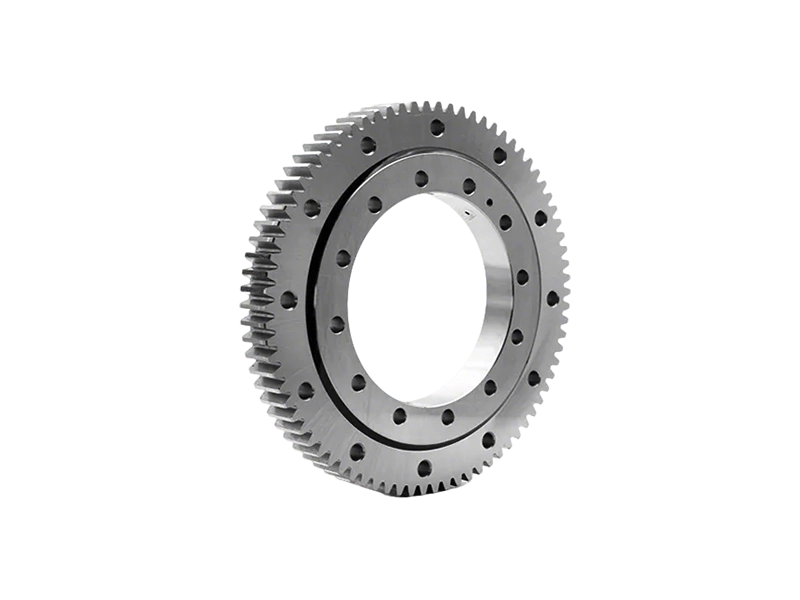
Crossed Roller Bearings for High-Load, Low-Friction Rotation
2026-07-21 02:39:17PRS Bearings
When equipment demands simultaneous high load capacity and minimal friction during rotation, conventional bearing designs often force compromises. Crossed roller bearings have emerged as a specialized solution that meets these opposing requirements through a unique cylindrical roller arrangement, delivering exceptional rigidity and rotational smoothness. For engineers seeking to optimize performance in precision rotary tables, robotics, or medical imaging systems, understanding the mechanics and selection criteria of these bearings is critical. PRS leverages decades of engineering expertise to provide custom crossed roller bearings that balance load support with near-frictionless motion.
Understanding Crossed Roller Bearings – Structure and Working Principle
Unique Roller Arrangement
Unlike conventional bearings that use rows of parallel rollers, crossed roller bearings position cylindrical rollers at right angles to one another within a single raceway – typically with alternating 90-degree offsets. Each roller is separated by a cage, but the cross layering allows the bearing to support radial, axial, and moment loads simultaneously from a single compact assembly. The rollers make line contact with the raceways, distributing forces over a larger area than ball bearings.
Load Distribution Characteristics
Because the rollers are arranged in alternating directions, each roller handles axial loads in one direction while its neighbor handles the opposite direction. This self-contained load sharing eliminates the need for paired bearings to manage bidirectional thrust. As a result, the bearing exhibits extremely high stiffness under combined loads, with minimal elastic deformation even at elevated preload levels. The line contact also reduces Hertzian stress concentrations, extending fatigue life under heavy cyclic loading.
Key Advantages for High-Load, Low-Friction Applications
Crossed roller bearings offer distinct performance benefits over traditional ball bearings, tapered roller bearings, or deep-groove designs in applications where precision and load capacity are paramount. The following table summarizes the comparative advantages:
- Higher Load Capacity per Size: Compared to ball bearings of the same cross-section, crossed roller bearings can handle up to 3× greater static and dynamic loads due to line contact geometry.
- Superior Rotational Accuracy: The preloaded roller set minimizes clearance and runout, enabling rotational accuracy of less than 1 μm in precision grades.
- Reduced Friction Torque: Despite line contact, optimized roller profiling and low-friction cage materials keep torque coefficients comparable to ball bearings while outperforming cone-type roller bearings.
- Compact Multi-Directional Support: A single crossed roller bearing replaces two or three conventional bearings in applications requiring radial, axial, and moment stiffness – saving weight and space.
- Excellent Damping: The roller-raceway interface provides natural vibration damping, reducing resonance in high-speed indexing systems.
Application Areas Where Crossed Roller Bearings Excel
Machine Tool Rotary Tables
CNC rotary axes demand zero backlash and high torque stiffness. Crossed roller bearings are standard in fifth-axis tables, supporting heavy workpieces while maintaining sub-arc-second positioning.
Industrial Robots and Joints
Collaborative robots require bearings that handle complex loads from link weight and tool forces without compromising smoothness. PRS supplies crossed roller bearings for robot wrist and base joints, offering up to 50% lower friction than conventional designs.
Medical Imaging Equipment
CT gantries and MRI patient tables rely on silent, low-vibration rotation. The high radial and axial stiffness of crossed roller bearings ensures consistent image quality even under patient weight loads exceeding 300 kg.
Aerospace and Defense
From satellite antenna pointing mechanisms to missile seeker heads, the ability to operate with minimal lubrication in vacuum environments makes crossed roller bearings a trusted choice.
Selecting the Right Crossed Roller Bearing – Factors to Consider
Choosing an optimal crossed roller bearing for a specific application involves evaluating several parameters:
- Load Magnitude and Direction: Specify combined radial, axial, and moment loads at rest and during acceleration. PRS customizes roller dimensions and number of rollers to match specific load envelopes.
- Speed Requirements: While crossed roller bearings are not intended for ultra-high RPM (typically max 500–1000 RPM depending on size), they excel in slow to moderate speed precision rotation. Cage design and lubrication must align with the duty cycle.
- Accuracy Grade: Standard classes (P0, P6, P5) satisfy most industrial needs; P4 and P2 are available for sub-micron applications. Preload is factory-set to achieve specified stiffness without overheating.
- Lubrication and Seals: Grease-packaged for moderate speeds; oil-mist or solid lubricants for vacuum or extreme temperature environments. Contact seals effectively exclude contaminants in harsh shop conditions.
- Mounting and Housing Fit: Flanged or inner/outer race mounting? PRS provides mounting recommendations to avoid distortion during installation.
Why Partner with PRS for Crossed Roller Bearings?
With over a decade of specialized manufacturing, PRS provides more than standard catalog bearings. Our engineering team collaborates closely with clients to produce custom crossed roller bearings with:
- Tailored Raceway Geometry: Crowned or modified roller profiles to optimize stress distribution.
- Advanced Materials: Through-hardened bearing steel (GCr15/SUJ2), stainless steel (440C, 316), or ceramic rollers for corrosion/weight savings.
- Integrated Features: Pre-drilled mounting holes, integral gears, or sensor pockets for OEM assemblies.
- Rigorous Testing: Every bearing is inspected for dimensional accuracy, residual magnetism, and torque consistency before shipment.
PRS maintains a rapid prototyping capability – we can deliver pre-production samples in under three weeks for urgent development programs.
Frequently Asked Questions
Can crossed roller bearings handle misalignment?
Crossed roller bearings are designed for rigid, precision alignment. They have limited self-aligning capability. For applications with shaft deflection or housing misalignment, a double-row crossed roller bearing with a spherical raceway (special order from PRS) may be considered.
How often must crossed roller bearings be lubricated?
It depends on speed, temperature, and contamination. Under normal CNC table usage with grease, relubrication intervals are typically 6–12 months. PRS offers maintenance schedules based on your actual operating conditions.
What is the typical lead time?
Standard sizes (40–200 mm bore) from PRS stock ship within 2 weeks. Custom designs require 4–6 weeks depending on complexity.
To discuss your specific high-load, low-friction rotation requirements, contact PRS today to speak with a bearing applications engineer.


 XRT Series Crossed Tapered Roller Bearings
 XV Series Crossed Cylindrical Roller Bearing
 XRU Crossed Roller Bearings
 XRSU Crossed Roller Bearings
 XRE Crossed Roller Bearings
 XRC Crossed Roller Bearings
 XRBH Crossed Roller Bearings
 XRB Crossed Roller Bearings
 Ultra Thin XRBS Crossed Roller Bearings
 Ultra Thin XRA-C Crossed Roller Bearings
 Ultra Thin XRA Crossed Roller Bearings
 XRBC Crossed Roller Bearings