
When engineers evaluate bearing solutions for high-precision equipment, rigidity becomes a decisive factor rather than just a performance metric. Whether the application involves CNC machine tools, industrial robots, medical devices, or semiconductor equipment, insufficient rigidity often leads to vibration, positioning errors, and premature wear. This article explains the real differences between crossed roller bearings and angular contact ball bearings, with a strong focus on rigidity, helping you make a technically sound and commercially practical choice.
Understanding Rigidity in Bearing Applications
Rigidity refers to a bearing’s ability to resist deformation under load. In practical terms, it determines how much displacement occurs when forces act on the system. A bearing with high rigidity maintains positional accuracy, reduces deflection, and improves machining quality or motion stability.
Rigidity depends on several factors:
Contact geometry between rolling elements and raceways
Internal clearance or preload
Material properties and heat treatment
Load direction and distribution
Both crossed roller bearings and angular contact ball bearings are designed for precision applications, but their internal structures lead to very different rigidity characteristics.
What Is a Crossed Roller Bearing?
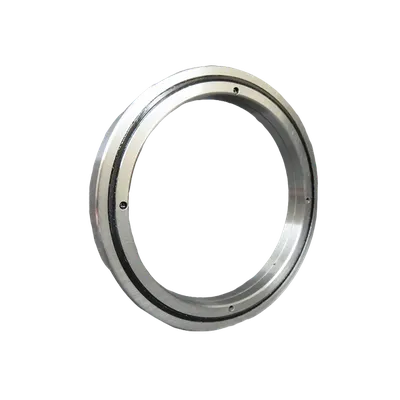
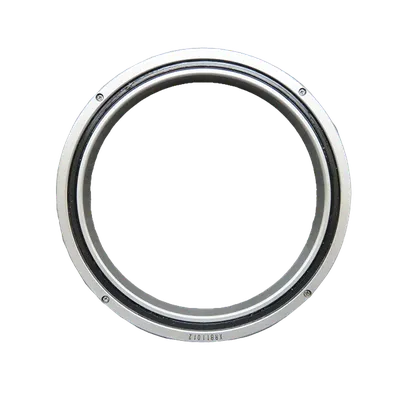
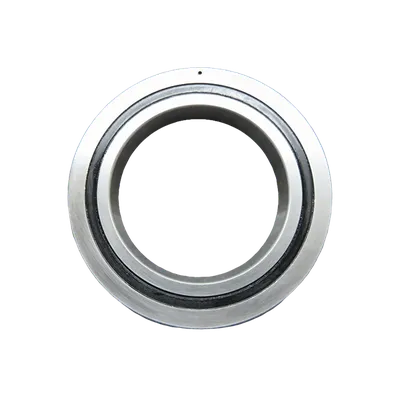
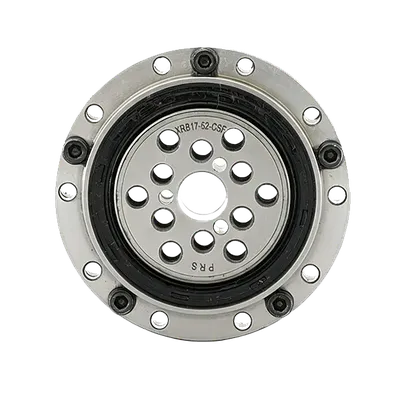
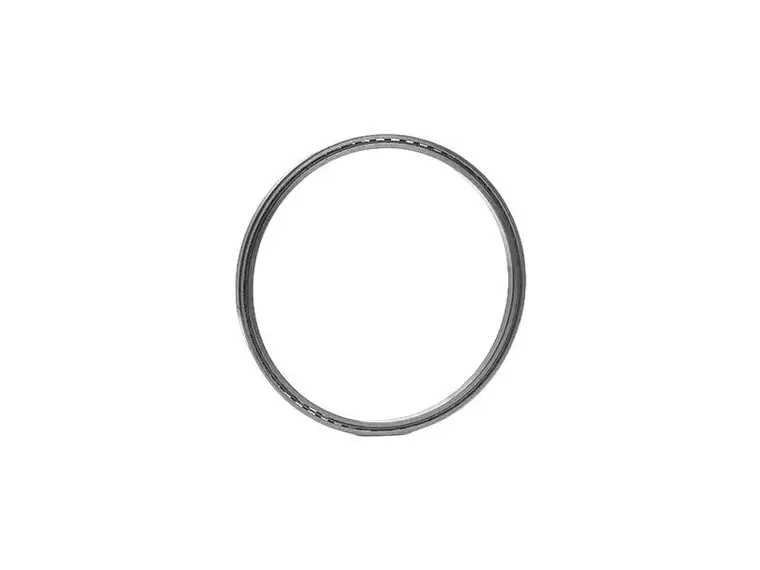
A crossed roller bearing features cylindrical rollers arranged orthogonally (at 90 degrees) between inner and outer rings. Each roller alternates in orientation, allowing the bearing to handle radial, axial, and moment loads simultaneously.
Key Structural Advantage
Because rollers have line contact with raceways, the load distributes over a larger contact area compared to point contact in ball bearings. This design significantly increases stiffness.
Rigidity Performance
Crossed roller bearings typically deliver:
Extremely high rigidity under multi-directional loads
Minimal elastic deformation
Superior resistance to tilting moments
This makes them ideal for applications where even micron-level deflection is unacceptable.
What Is an Angular Contact Ball Bearing?
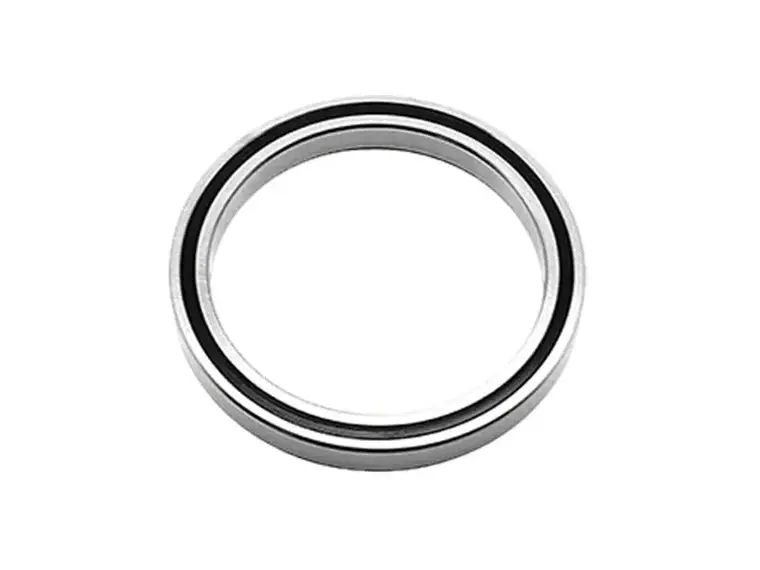
An angular contact ball bearing uses balls as rolling elements, with raceways designed to support loads at a specific contact angle. These bearings are often installed in pairs or sets to handle combined loads.
Key Structural Advantage
The point contact between balls and raceways reduces friction and allows for higher rotational speeds. Engineers often use preload configurations to enhance stiffness.
Rigidity Performance
Angular contact ball bearings provide:
Moderate to high rigidity depending on preload
Good axial load support in one direction (or both when paired)
Flexibility in configuration (back-to-back, face-to-face, tandem)
However, due to point contact, their inherent rigidity is lower than that of roller-based designs.
Direct Comparison: Rigidity Matters
1. Contact Type: Line vs. Point
Crossed roller bearings rely on line contact, which spreads the load across a larger surface. Angular contact ball bearings rely on point contact, concentrating stress at smaller areas.
Result: Crossed roller bearings achieve higher stiffness and lower deformation.
2. Load Distribution
Crossed roller bearings distribute loads evenly across multiple rollers in different orientations. Angular contact ball bearings distribute loads through fewer contact points.
Result: Crossed roller bearings maintain rigidity under complex loads more effectively.
3. Moment Load Capacity
Applications such as robotic arms or rotary tables often involve overturning moments. Crossed roller bearings inherently resist these moments due to their geometry.
Angular contact ball bearings require matched pairs or complex arrangements to achieve similar performance.
Result: Crossed roller bearings outperform in moment rigidity.
4. Preload Sensitivity
Angular contact ball bearings depend heavily on preload to increase rigidity. Incorrect preload leads to either excessive deformation or overheating.
Crossed roller bearings achieve high rigidity even with minimal preload.
Result: Crossed roller bearings offer more stable rigidity with less tuning.
5. Space Efficiency
Crossed roller bearings integrate multiple load directions into a single compact unit. Angular contact ball bearings often require multiple bearings and spacers.
Result: Crossed roller bearings provide higher rigidity in limited installation space.
When Angular Contact Ball Bearings Still Make Sense
It would be misleading to claim crossed roller bearings are always the better option. Angular contact ball bearings remain a strong choice in certain scenarios:
High-speed applications where low friction is critical
Cost-sensitive projects with moderate rigidity requirements
Systems requiring flexible mounting configurations
Applications where thermal expansion must be carefully managed
In these cases, engineers often accept slightly lower rigidity in exchange for speed, efficiency, and cost advantages.
Typical Applications Comparison
Crossed Roller Bearings
Industrial robots (joint rotation units)
CNC rotary tables
Precision measuring instruments
Semiconductor manufacturing equipment
Medical imaging systems
Angular Contact Ball Bearings
Machine tool spindles
Pumps and compressors
Automotive components
General industrial machinery
Real-World Engineering Insight
In precision industries such as robotics and CNC machining, rigidity directly impacts product quality. A robotic arm using crossed roller bearings can maintain repeatability over long cycles without recalibration. In contrast, a system using angular contact ball bearings may require periodic adjustment due to micro-deformation.
However, in high-speed spindles, angular contact ball bearings often outperform crossed roller bearings because excessive rigidity can increase heat generation and reduce rotational efficiency.
This trade-off highlights an important engineering principle: the “best” bearing depends on the dominant performance requirement, not just one parameter.
Cost vs. Performance Consideration
Crossed roller bearings typically have higher manufacturing complexity and cost. Their precision machining, assembly, and quality control requirements increase the price.
Angular contact ball bearings benefit from standardized production and wider availability, making them more economical.
However, if a design fails due to insufficient rigidity, the cost of downtime, maintenance, or product defects will quickly exceed the initial savings.
Final Verdict: Which Is Better for Rigidity?
If rigidity is your primary concern, crossed roller bearings are the clear winner. Their line contact structure, multi-directional load capacity, and inherent resistance to deformation make them superior for high-precision and high-stiffness applications.
If your application prioritizes speed, cost efficiency, or flexible configurations, angular contact ball bearings remain a practical and widely used solution.
Practical Selection Advice
When selecting between these two bearing types, you should:
Define load types (radial, axial, moment)
Evaluate acceptable deformation limits
Consider installation space constraints
Analyze operating speed and thermal conditions
Balance upfront cost with lifecycle performance
A well-informed decision will not only improve system performance but also enhance long-term reliability and reduce maintenance costs.
Conclusion
The debate between crossed roller bearings and angular contact ball bearings ultimately comes down to application priorities. Engineers who demand maximum rigidity, precision, and stability consistently choose crossed roller bearings. Meanwhile, angular contact ball bearings continue to dominate applications where speed and cost efficiency are more critical.
By understanding the structural and performance differences, you can align your bearing selection with real operational needs, ensuring both technical success and commercial value.